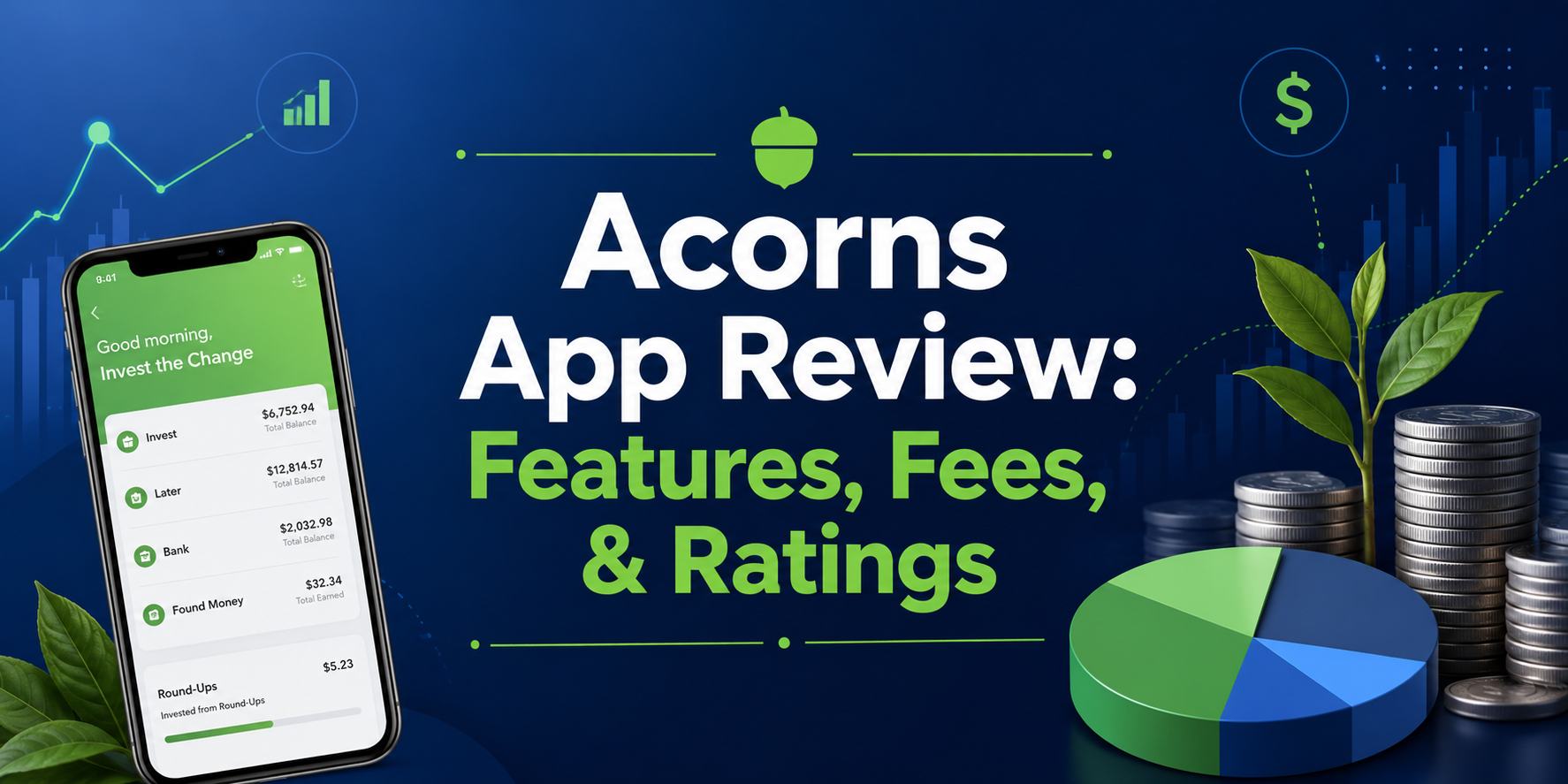
Acorns App Review 2026: Features, Fees, & Ratings
Acorns remains one of the easiest investing apps for beginners who want to automate saving and investing rather than actively pick stocks. Its signature Round-Ups® feature turns spare change from everyday purchases into investments, while the broader platform now combines investing, retirement, banking, savings, and family-focused financial tools.
Acorns offers three subscription plans: Bronze at $4 per month, Silver at $8 per month, and Gold at $12 per month for new subscribers. The app holds a 4.7/5 rating on both the Apple App Store and Google Play, although individual user experiences vary.
Quick verdict:
- Best for: Beginner and hands-off investors
- Standout feature: Automated Round-Ups and recurring investing
- Biggest drawback: Flat monthly fees can be expensive for very small portfolios
- Global availability: Primarily designed for eligible U.S. residents
- Overall: A strong financial wellness platform, but not necessarily the best choice for active stock traders
Introduction
For many people, the hardest part of investing is not understanding the concept. It is getting started and staying consistent. This is the problem that Acorns has spent more than a decade trying to solve.
Acorns is built around a simple behavioural-finance idea: small amounts of money invested regularly can become meaningful over time. Instead of asking users to choose individual stocks or time the market, the app encourages automated investing through spare-change round-ups, recurring contributions, diversified portfolios, and goal-based accounts.
The platform has expanded significantly beyond its original micro-investing proposition. In 2026, Acorns combines investment accounts with retirement investing, checking, emergency savings, financial education, rewards, and family-oriented products depending on the subscription tier. Acorns says more than 14 million customers have used its platform, with over $30 billion invested since its inception.
However, Acorns is not automatically the right choice for everyone. A flat monthly subscription can consume a meaningful percentage of returns for investors with small balances. International readers should also note that the platform is primarily intended for eligible U.S. residents and is not a globally available brokerage service.
So, is Acorns worth paying for in 2026? This review examines its features, fees, ratings, strengths, weaknesses, and ideal user profile.
Is Acorns Worth It in 2026?
Yes, Acorns can be worth it for beginners and hands-off investors who value automation and financial simplicity. It is less attractive for active investors, experienced stock pickers, or people with very small balances who are highly fee-sensitive.
The value proposition of Acorns is not simply access to ETFs. Investors can access diversified ETFs through many low-cost or commission-free brokers. What Acorns sells is automation and behavioural consistency.
For example, imagine someone spends $3.60 on coffee. With Round-Ups enabled, Acorns can round that purchase up to $4 and invest the additional $0.40. One transaction will not change anyone’s financial future, but hundreds of small automated contributions can build an investing habit.
The same principle applies to recurring investments. Rather than waiting until they have a large lump sum, users can schedule regular contributions and let the process continue in the background. Acorns allows recurring investments from as little as $5, according to its product information.
The main question is whether the subscription fee makes sense relative to the amount invested. Paying $4 per month means paying $48 per year before considering investment gains or losses. For an investor with only a few hundred dollars in the account, that fixed fee can represent a relatively high percentage of assets.
Therefore, Acorns becomes more compelling when users actively use multiple features, maintain a growing portfolio, and genuinely benefit from automation. For someone who only wants to buy a few stocks occasionally, a traditional brokerage may offer better value.
How Does the Acorns App Work?
Acorns works by combining automated contributions with professionally constructed investment portfolios. Users generally complete a short onboarding process, after which the platform recommends a diversified portfolio based on their goals and preferences.
The core investing account is Acorns Invest, which enables users to invest spare change, make one-time deposits, or set recurring investments. Acorns states that its portfolios use diversified ETFs and can provide exposure across thousands of underlying stocks and bonds. The platform also automatically rebalances portfolios toward their intended allocation.
The best-known feature is Round-Ups®. Users can link eligible spending accounts, and qualifying purchases can be rounded up to the next dollar. Once the round-ups reach the applicable transfer threshold, the money can be invested.
For example:
- A $4.25 purchase could generate a $0.75 round-up.
- A $12.80 purchase could generate a $0.20 round-up.
- Across dozens of transactions, those small amounts can accumulate into an investment contribution.
Acorns also supports recurring investing, which is arguably more important than Round-Ups for users who want to build wealth consistently. Investors can schedule contributions rather than relying solely on spare change.
The broader ecosystem can also include an IRA through Acorns Later, banking features, emergency savings, educational content, and family-oriented financial tools, depending on the subscription selected. This creates a more comprehensive financial wellness experience than a basic micro-investing app.
The trade-off is simplicity versus control. Acorns is designed to make investing easier, not to provide the advanced trading tools that sophisticated investors may expect.
Acorns App Features: What Do You Get?
Acorns has evolved from a spare-change investing app into a broader financial platform. The most useful features depend on your subscription tier and financial goals.
1. Acorns Invest and diversified portfolios
Acorns Invest is the core of the platform. Users receive access to diversified portfolios rather than having to research and select individual securities themselves. This approach can suit investors who want broad market exposure without actively managing every investment decision.
2. Round-Ups®
Round-Ups remains Acorns’ most distinctive feature. It turns everyday spending into a potential investment trigger and can make saving feel less intimidating. For behavioural reasons, this can be particularly useful for first-time investors.
3. Recurring investments
Users can automate regular contributions, helping create a disciplined long-term investing habit. Acorns allows users to start recurring investments with relatively small amounts, making the platform accessible to people who do not want to begin with a large lump sum.
4. Acorns Later
Acorns Later provides retirement investing through an IRA structure recommended based on a user’s goals, employment, and income information. Retirement accounts are particularly relevant for U.S.-based investors looking to combine long-term investing with potential tax advantages.
5. Acorns Checking and savings tools
Depending on the plan, Acorns offers checking and emergency savings functionality. The company states that its checking offering has no minimum balance or overdraft fees and provides access to the Allpoint ATM network.
6. Acorns Earn
Acorns Earn allows users to earn bonus investments through eligible partner offers. This adds a rewards component to the ecosystem and can be appealing to users who regularly shop with participating brands.
7. Family and children’s financial tools
The Gold plan expands Acorns’ proposition to families. It includes investment options for children and access to Acorns Early, a financial app and debit card designed for kids. The plan also includes additional benefits such as selected financial services and insurance-related benefits.
8. Custom portfolios and individual securities
Gold subscribers can access more investment flexibility, including the ability to add individual stocks and ETFs to a portfolio. This is a notable shift from Acorns’ traditional fully managed approach and makes the platform more appealing to investors who want some personalisation.
Acorns Fees and Pricing in 2026
Acorns uses a flat monthly subscription model rather than charging traditional per-trade commissions. For new subscribers as of August 2026, the primary plans are Bronze at $4 per month, Silver at $8 per month, and Gold at $12 per month.
| Plan | Monthly Fee | Best For |
| Bronze | $4 | Beginners who want automated investing and core financial tools |
| Silver | $8 | Users who want additional savings, education, and retirement benefits |
| Gold | $12 | Families and investors seeking the broadest feature set |
Acorns’ pricing structure changed in August 2026, so some existing subscribers may have different legacy pricing depending on when they signed up. Its current program documentation distinguishes between earlier subscription pricing and the pricing applicable to newer sign-ups.
Bronze: $4 per month
Bronze is the entry-level plan and includes Acorns Invest, Round-Ups®, Acorns Later, checking-related functionality, and educational resources.
Silver: $8 per month
Silver adds features such as emergency savings, enhanced financial education, live Q&As, and a 1% IRA match on eligible new contributions during the first year, according to Acorns’ current plan information.
Gold: $12 per month
Gold is designed as the full financial wellness and family plan. It includes higher retirement-match benefits during the first year, children’s investment and money tools, portfolio customisation, and additional services and benefits.
The flat-fee model is easy to understand. However, investors should always compare the dollar cost against their account balance. A fixed fee is proportionally less significant for a $20,000 portfolio than for a $200 portfolio.
Acorns App Ratings and Customer Reviews
Acorns has strong overall app-store ratings, suggesting that a large number of users value its simplicity and automated investing experience.
At the time of writing, the Acorns app has a 4.7 out of 5 rating from approximately 957,000 ratings on Apple’s App Store. On Google Play, it also has a 4.7 out of 5 rating, with roughly 404,000 reviews shown in a recent listing snapshot. Ratings and review counts naturally change over time.
Positive reviews frequently focus on:
- Ease of use
- Automatic investing
- The ability to build investing habits
- A simple interface for beginners
- The convenience of keeping multiple financial tools in one ecosystem
However, reviews also reveal recurring concerns. Some users want greater investment choice and more advanced functionality. Others have raised issues involving customer support, account linking, or the reliability of specific automated features. Individual experiences vary, and app-store reviews should not be treated as representative of every user’s experience.
For fintech professionals, the ratings are particularly interesting because they demonstrate Acorns’ success in turning a traditionally complex activity (investing) into a relatively low-friction mobile experience. Its strongest product advantage may be user engagement and behavioural design rather than sophisticated investment technology alone.
Is Acorns Safe and Legit?
Acorns is a legitimate U.S. financial platform, but investors should understand that legitimate investing services still involve market risk. SIPC or FDIC protections do not guarantee investment returns.
Acorns says its investment advisory services are offered through an SEC-registered investment adviser, while brokerage services are provided through an SEC-registered broker-dealer and FINRA/SIPC member. Securities protection through SIPC is subject to applicable limits, while eligible banking products have separate FDIC insurance arrangements through partner banks.
The platform also highlights security features such as two-factor authentication and encryption.
However, investors should distinguish between platform protection and investment protection. A diversified ETF portfolio can still decline in value when markets fall. No investment app can eliminate market risk.
From a regulatory and product perspective, Acorns has the infrastructure expected of an established U.S. fintech platform. From an investment perspective, users should still assess their own risk tolerance, investment horizon, and financial circumstances.
Acorns Pros and Cons
Pros
- Extremely beginner-friendly investing experience
- Round-Ups can help users build an investing habit
- Recurring investments encourage consistency
- Diversified portfolios reduce the need to select individual securities
- Combines investing, retirement, banking, and savings tools
- Strong app-store ratings across iOS and Android
- Family-focused tools are available on higher-tier plans
Cons
- Monthly subscription fees can be costly for small account balances
- Limited appeal for active traders and stock pickers
- Many premium features require higher-priced plans
- The platform is primarily built for the U.S. market
- Some users report customer-service or account-linking frustrations
- Investment returns are not guaranteed
The biggest strategic advantage of Acorns is simplicity. Its biggest limitation is also simplicity: investors who want deeper control may outgrow the platform.
Acorns for a Global Audience: Availability and Limitations
Acorns is a well-known fintech brand internationally, but the core service is not a globally available investing platform. Its official terms and disclosures state that the platform is intended primarily for eligible U.S. citizens or lawful U.S. residents located in the United States, subject to applicable eligibility requirements.
This matters for readers in markets such as India, the UK, Singapore, the Middle East, or Europe. The Acorns app may be visible in international app stores or discussed by global fintech media, but that does not necessarily mean users in those countries can open and operate an investment account.
The Acorns model is nevertheless globally relevant. Its combination of micro-investing, automated contributions, behavioural nudges, and mobile-first design has influenced fintech products worldwide. Similar concepts appear in digital wealth platforms and neobanks across multiple regions.
For international fintech professionals, Acorns is therefore worth studying as a product and customer-engagement case study, even when the platform itself is not available in their market.
Who Should Use Acorns and Who Should Avoid It?
Acorns is best suited to people who want investing to happen with minimal effort. A beginner with limited investing knowledge may benefit from diversified portfolios and automation more than from an app filled with advanced trading features.
It can be particularly useful for:
- First-time investors
- Busy professionals
- People who struggle to invest consistently
- Users who prefer a hands-off approach
- Families seeking integrated financial tools
- Long-term investors comfortable with diversified ETFs
On the other hand, Acorns may not be ideal for day traders, frequent stock pickers, or highly cost-sensitive investors with very small balances. Those users may prefer a brokerage with more investment choices and no recurring platform subscription.
The best investing app is ultimately not the one with the most features. It is the one whose pricing, investment options, automation, and user experience match how you actually manage money.
Key Takeaways
- Acorns is strongest as an automated investing platform, helping beginners build consistent financial habits through Round-Ups, recurring contributions, diversified portfolios, and integrated financial tools.
- The app offers three main plans in 2026 (Bronze, Silver, and Gold) with current new-subscriber pricing of $4, $8, and $12 monthly.
- Flat subscription fees are easy to understand but can be disproportionately expensive for investors with very small account balances or limited use of premium features.
- Acorns earns strong app-store ratings, with a 4.7/5 score on both major mobile platforms, although customer-service experiences and feature reliability can vary.
- The platform is designed primarily for hands-off, long-term investors rather than active traders seeking extensive stock research, technical analysis, or advanced portfolio control.
- Acorns combines investing with retirement, banking, savings, education, rewards, and family features, making it more of a financial wellness ecosystem than a basic investing app.
- For global fintech users, Acorns is an influential product model, but the investment platform itself is primarily intended for eligible U.S. residents.
Conclusion
Acorns remains one of the most recognisable names in consumer fintech because it solves a genuine problem: many people know they should invest but struggle to make investing a regular habit.
In 2026, the platform is no longer just a spare-change investing app. Its Bronze, Silver, and Gold subscriptions offer an increasingly broad set of financial services, ranging from diversified investing and retirement accounts to emergency savings, financial education, family tools, and portfolio customisation.
The biggest factor to consider is value for money. The flat subscription model works best when the user has a meaningful and growing account balance or actively uses several Acorns products. For an investor contributing only small amounts and using only the basic investment account, cheaper alternatives may be available.
For its target audience, however, Acorns does what it promises. It reduces friction, automates positive financial behaviour, and makes long-term investing more approachable.
OUR VERDICT: Acorns is a strong choice for beginners and hands-off investors who prioritise convenience and consistency over advanced investment control. Active traders and international users should look carefully at availability and alternatives before signing up.
FAQs
1. Is Acorns worth paying for in 2026?
Acorns can be worth it if you regularly use its automation, investing, retirement, banking, or family tools. The monthly fee may be less attractive for very small portfolios.
2. How much does Acorns cost per month?
For new subscribers, Acorns lists Bronze at $4 monthly, Silver at $8 monthly, and Gold at $12 monthly. Legacy subscribers may have different pricing arrangements.
3. Is Acorns a good app for beginners?
Yes. Acorns is particularly beginner-friendly because it automates investing, provides diversified portfolios, and reduces the need to research or select individual stocks yourself.
4. Can I lose money with Acorns?
Yes. Acorns investments can rise or fall with financial markets. Diversification may reduce certain risks, but it does not guarantee profits or prevent investment losses.
5. What is Acorns’ Round-Ups feature?
Round-Ups automatically round eligible purchases to the next dollar and invest the spare change. It is designed to help users invest small amounts consistently over time.
6. Is Acorns available outside the United States?
Acorns’ core platform is primarily intended for eligible U.S. citizens or lawful U.S. residents. International users should check official eligibility requirements before attempting to register.