
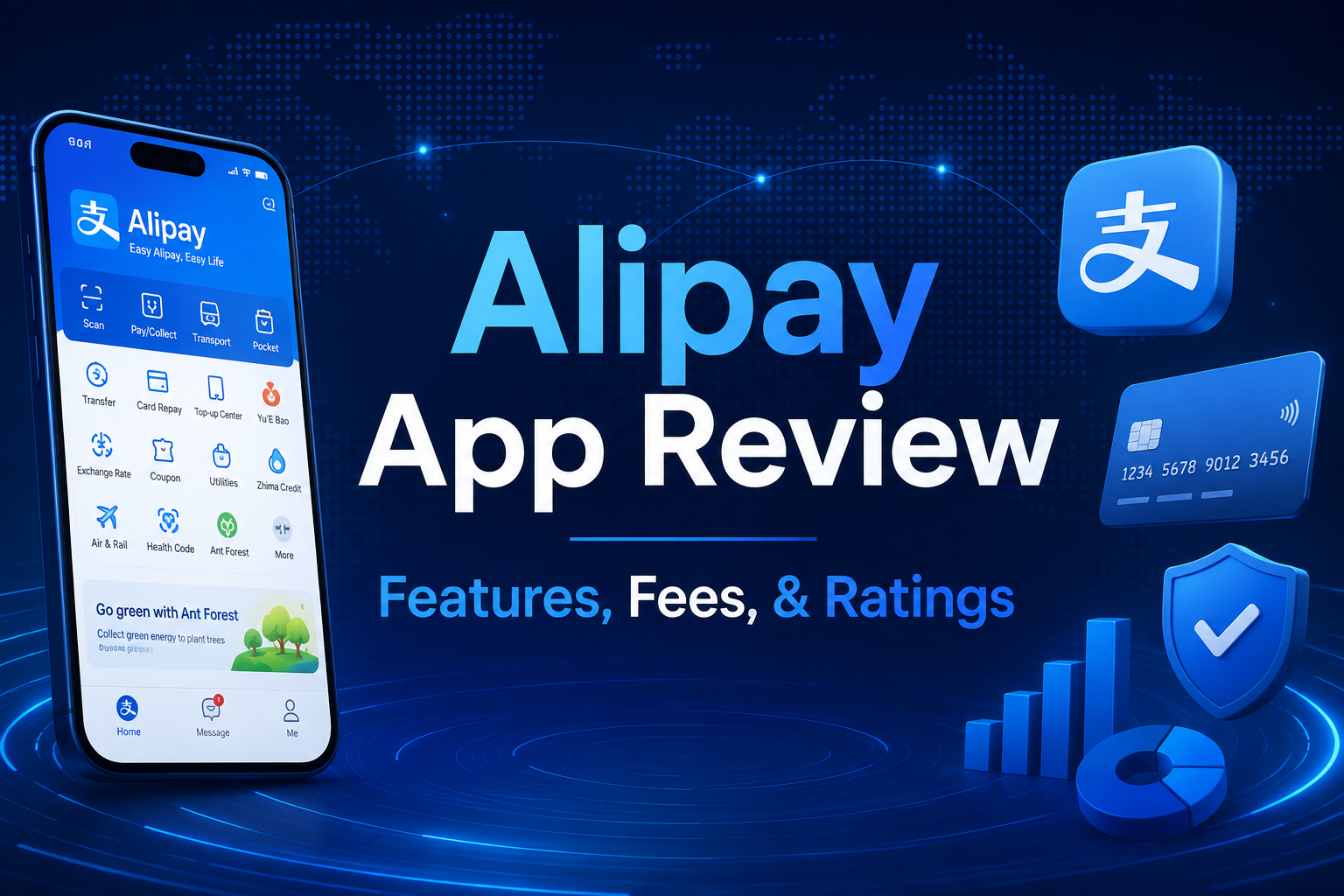
Alipay App Review 2026: Features, Fees, & Ratings
Alipay is one of the most important fintech apps for anyone living in, doing business in, or travelling to mainland China. In 2026, its biggest strength is still its enormous payment acceptance network and its evolution into a broader digital-services platform.
International visitors can now link eligible overseas cards and use Alipay at tens of millions of merchants, although the experience can still involve verification requirements, language issues, and transaction fees on larger purchases.
Key points:
- Best for: Payments and everyday digital services in mainland China.
- International users: Can link eligible overseas cards for everyday purchases in China.
- Fees: Official government guidance states that foreign-card transactions of RMB 200 or below generally have no additional service fee, while transactions above RMB 200 may incur a 3% fee.
- App ratings: The Google Play and Apple App Store ratings are relatively low compared with Alipay’s importance and reach, highlighting ongoing user-experience challenges for some international users.
- Verdict: An essential app for many China visitors, but not always the smoothest onboarding experience.
Introduction
Few fintech apps illustrate the scale and ambition of the digital economy as clearly as Alipay. What began as a payment solution has evolved into a major digital platform connecting payments with shopping, transportation, lifestyle services, financial products, and other everyday activities. For consumers in mainland China, Alipay is embedded deeply into the digital economy. For international travellers, it has increasingly become a practical gateway to navigating China’s highly cashless payment environment.
That context matters when reviewing the app. Alipay is not simply competing with a standalone mobile wallet such as PayPal, Cash App, or Revolut. Its closest comparison is a super app; a platform designed to bring multiple services and payment experiences into a single digital ecosystem.
In 2026, Alipay’s relevance is also increasingly global. Ant International has continued to expand its cross-border payment ecosystem through Alipay+, connecting wallets, payment partners, consumers, and merchants across multiple markets. The wider Alipay+ ecosystem has reported expanding payment connectivity across more than 100 countries and regions, demonstrating how mobile wallets are becoming part of global payment infrastructure rather than purely domestic products.
But does the Alipay app itself deliver a good user experience in 2026? This review examines its features, fees, international usability, ratings, advantages, and limitations from the perspective of fintech professionals, investors, and everyday users.
What Is Alipay and Is It Worth Using in 2026?
Alipay is worth using in 2026 if you need to make payments or access digital services in mainland China. For international visitors, it can be particularly useful because it allows eligible overseas cards to be linked to a payment platform accepted by tens of millions of merchants.
Alipay is operated by Alipay (Hangzhou) Technology and is part of the broader Ant Group ecosystem. The app has grown far beyond its original role in online payments. Today, it functions as an open platform for payments and digital services, reflecting China’s broader shift toward mobile-first commerce.
The app’s value proposition differs depending on who you are.
For a Chinese resident with access to local banking services, Alipay can support a wide range of daily activities. For a foreign visitor, its primary value is much more straightforward: enabling convenient digital payments where international card acceptance alone may not always provide the same level of convenience.
The Google Play listing specifically states that foreign visitors to China can connect credit cards to access Alipay’s extensive merchant network. However, it also makes an important limitation clear: Alipay is not designed as a general-purpose wallet for foreign users to use in their home countries or everywhere outside China.
That distinction is important. Alipay should not be evaluated as a global travel card or universal cross-border banking app. Its greatest strength is local relevance at an extraordinary scale.
For travellers visiting China, that can make it highly valuable. For users who do not visit or transact in China, its usefulness is significantly more limited.
Alipay App Features: What Can You Do With It?
Alipay’s core feature is digital payment, but its broader ecosystem is what makes the app strategically interesting. The platform combines wallet functionality with QR-code payments and access to a wide range of digital services, making it closer to a financial and lifestyle ecosystem than a traditional payment app.
1. QR-code payments
QR-code payments remain central to the Alipay experience. Users can scan a merchant’s QR code or display their own payment code for the merchant to scan. This simple interaction has helped make mobile payments deeply integrated into everyday commerce across China.
For visitors accustomed to tapping a physical card or using Apple Pay, QR payments may initially feel unfamiliar. However, they are widely embedded in the local merchant experience.
2. Card linking for international visitors
One of the most important developments for international users has been the ability to link eligible overseas cards. Official guidance for foreign visitors indicates that major international card networks can be supported, subject to eligibility and verification requirements.
This reduces the need for visitors to open a local bank account simply to participate in mobile commerce.
3. Digital services and mini-program-style experiences
Alipay also provides access to services beyond payments. Depending on the user’s account, location, and eligibility, these can include transportation, food and lifestyle services, healthcare-related services, and other third-party experiences.
The platform model is particularly important from a fintech perspective. Instead of requiring users to download and manage a separate app for every transaction category, Alipay can serve as a distribution layer for multiple services.
4. Financial ecosystem integration
For eligible users, Alipay’s broader ecosystem includes access to financial products and services. These features are not universally available to every international user and are subject to local regulations and account eligibility.
This is one reason Alipay is strategically significant: it demonstrates how payments can act as the entry point into a much broader financial ecosystem.
5. Cross-border connectivity
Alipay+ extends the wider payment ecosystem beyond the domestic Alipay app. By 2026, Ant International described the Alipay+ network as connecting billions of user accounts with a large international merchant network, reflecting the increasing importance of wallet interoperability in global fintech.
For fintech professionals, this may be one of the most interesting aspects of the Alipay story: the transition from a domestic wallet into infrastructure supporting cross-border wallet connectivity.
Alipay Fees in 2026: Is Alipay Free to Use?
Alipay’s fees depend heavily on the payment method and transaction type. For international visitors using a linked overseas card for everyday purchases in mainland China, official guidance has generally stated that transactions of RMB 200 or below do not attract an additional service fee, while transactions above RMB 200 may incur a 3% fee.
This is an important consideration for travellers.
For example, a small RMB 50 taxi or coffee payment may not trigger an additional Alipay service fee under the published foreign-card guidance. A larger hotel, shopping, or dining transaction above the RMB 200 threshold could be more expensive because of the percentage-based fee.
However, users should also distinguish between:
- Alipay service fees
- Foreign exchange rates
- Card-network conversion costs
- Fees charged by the issuing bank
The exchange rate applied to an international card transaction may depend on the card network and the issuing bank. This means the final cost of a payment can differ from the price displayed by the merchant even when Alipay itself does not charge an additional fee.
Fees can also change over time and may differ across products, transaction types, and regions. Users should therefore check the payment confirmation screen and current in-app terms before making a large purchase.
Alipay fee summary for international visitors
| Transaction type | Typical cost consideration |
| Small foreign-card purchase of RMB 200 or below | Published guidance generally indicates no additional service fee |
| Foreign-card purchase above RMB 200 | Published guidance indicates a potential 3% service fee |
| Currency conversion | May depend on the card network and issuing bank |
| Other Alipay products | Fees vary by service and eligibility |
For frequent travellers making larger payments, this pricing structure can materially affect the overall cost of using the app.
How Easy Is Alipay for International Users?
Alipay is much more accessible to international visitors than it was a few years ago, but accessibility does not always mean a frictionless user experience.
Official visitor guidance indicates that foreigners can register using an international mobile number capable of receiving verification messages and link eligible international cards. Passport-based identity verification may also be required depending on the account and transaction.
The basic onboarding process typically involves:
- Downloading the Alipay app.
- Registering with a mobile number.
- Completing identity verification where required.
- Linking an eligible payment card.
- Using the app to scan or present QR codes at merchants.
For many users, the process works successfully. However, app-store reviews reveal a recurring set of pain points around verification, card linking, account restrictions, translations, and customer support.
The Google Play listing, for example, currently shows a rating of around 2.6 out of 5 from tens of thousands of reviews, while the US App Store listing shows approximately 2.9 out of 5 from thousands of ratings. These scores should not be interpreted as a measure of Alipay’s overall market importance; instead, they highlight that a powerful ecosystem can still create a frustrating experience for certain user segments, especially international users navigating onboarding and language differences.
This creates an interesting product lesson for fintech companies: network scale and customer experience are not the same thing. Alipay’s acceptance network can be exceptionally valuable even when parts of the onboarding journey require improvement.
Alipay Ratings and User Reviews
Alipay’s current app-store ratings are surprisingly modest for a platform with such enormous strategic and commercial importance. This suggests that international users should evaluate the app based on their specific use case rather than ratings alone.
As of the latest available app-store listings reviewed for this article:
- Google Play: Approximately 2.6/5, based on around 83,000 reviews, with more than 10 million downloads shown on the listing.
- Apple App Store (US): Approximately 2.9/5, based on around 4,200 ratings.
Several common themes appear in user feedback:
Positive experiences often focus on the convenience of being able to pay in a highly digital Chinese marketplace, especially after successfully linking an international card.
Negative experiences frequently mention identity verification, card-linking problems, account restrictions, translation quality, and difficulty accessing support.
The lesson is simple: Alipay is a highly capable app, but the experience is not identical for every user. A Chinese resident using a domestic bank account and a traveller trying to link an overseas card are effectively interacting with different versions of the same ecosystem.
For international users, it is sensible to complete setup and verification before a trip rather than waiting until arriving at a restaurant, airport, or taxi stand where a payment is urgently needed.
Alipay Security and Privacy: Is the App Safe?
Alipay is a major, established payment platform operating within a heavily regulated and technologically sophisticated financial ecosystem. From a general consumer perspective, it is widely used for payments in China and includes security controls appropriate for a large-scale financial platform.
The Google Play data-safety section states that data is encrypted in transit and that users can request data deletion, while also noting that the app may collect multiple categories of data depending on usage.
However, “safe” should be understood in two different ways.
First, there is transaction security. Alipay uses authentication and verification mechanisms designed to reduce unauthorized access and payment fraud.
Second, there is data privacy. Users should understand that large digital platforms can collect significant amounts of personal and transaction-related information, particularly when they operate as super apps rather than single-purpose payment tools.
International users should:
- Download the app from official app stores.
- Avoid sharing verification codes.
- Review card-linking and identity-verification prompts carefully.
- Use device-level security such as passcodes and biometrics.
- Monitor linked-card transactions.
- Review privacy terms relevant to their account and region.
For fintech professionals, Alipay remains a useful case study in the trade-off between personalization, ecosystem integration, and data collection.
Alipay vs. WeChat Pay and Other Payment Apps
The biggest comparison for Alipay in mainland China is typically WeChat Pay. Both are deeply integrated into China’s mobile-payment economy, and many travellers choose to set up more than one payment option before visiting.
Alipay’s broader identity is closely connected to commerce, financial services, and digital lifestyle services. WeChat Pay benefits from integration with the WeChat messaging ecosystem and the broader social and communication habits of its users.
For a foreign traveller, the practical question is often not “Which app is better?” but “Which one works reliably for my cards and the merchants I visit?”
Outside China, Alipay should not be compared directly with a global multi-currency platform such as Wise or Revolut. Those products focus more directly on cross-border money management, foreign exchange, and international spending. Alipay’s core value remains its connection to the Chinese digital ecosystem.
From a fintech-industry perspective, Alipay is also increasingly interesting because of the expansion of Alipay+. The broader ecosystem aims to connect international wallets and merchants, allowing consumers to use familiar payment apps across borders. Ant International has continued expanding this interoperability model through partnerships and payment-network integrations.
This model could influence the future of global payments: instead of every consumer downloading the same wallet, payment infrastructure may increasingly connect existing wallets with merchant networks.
Pros and Cons of Alipay
Pros
- Extensive merchant acceptance in China: One of Alipay’s biggest advantages is its deep integration into everyday commerce.
- Useful for international visitors: Eligible overseas cards can be linked for purchases in mainland China.
- More than a wallet: The app provides access to a broader ecosystem of digital and lifestyle services.
- Strong QR-payment experience: Convenient for in-store purchases where QR payments are common.
- Part of a growing cross-border ecosystem: Alipay+ is expanding wallet and merchant interoperability internationally.
Cons
- International onboarding can be frustrating: Verification and card-linking issues are recurring themes in user reviews.
- Foreign-card fees can be significant on larger transactions: A published 3% fee above the RMB 200 threshold can affect the cost of travel spending.
- Low app-store ratings: Current ratings suggest meaningful usability issues for some users.
- Limited relevance outside the China ecosystem: It is not designed as a universal payment solution for foreign users in their home countries.
- Complex ecosystem: New users may find the breadth of services less intuitive than a simpler payment app.
Who Should Use Alipay?
Alipay is best suited to people who need access to China’s digital payment ecosystem.
Best for:
International travellers to mainland China: If your eligible overseas card works with the app, Alipay can make everyday payments significantly more convenient.
Business travellers and expatriates: Frequent spending across transport, dining, shopping, and local services can make mobile-payment access particularly valuable.
People participating in China’s digital economy: Users who need access to local commerce and supported digital services may benefit from Alipay’s broader ecosystem.
Fintech professionals: Alipay is an important product to study because it demonstrates the evolution from digital wallet to super app and, increasingly, to cross-border payment infrastructure.
Less suitable for:
Users looking for a simple global wallet for everyday use outside China may find other products more appropriate. Similarly, travellers who want the lowest possible foreign-exchange costs should compare the total cost of using a linked card, including Alipay service fees and issuer fees.
Key Takeaways
- Alipay remains one of China’s most important fintech platforms, combining widespread digital payments with access to a broader ecosystem of consumer and financial services.
- For international travellers, linking an eligible overseas card can provide access to convenient QR payments across Alipay’s extensive mainland China merchant network.
- Foreign-card users should watch transaction costs carefully, as published guidance indicates a potential 3% service fee for transactions above RMB 200.
- Alipay’s relatively low app-store ratings highlight onboarding, verification, translation, and support challenges that can affect international users more than domestic users.
- The app is most valuable within the China ecosystem and should not be viewed as a universal global wallet for everyday use outside mainland China.
- Alipay+ demonstrates the broader strategic opportunity for wallet interoperability, connecting payment apps, merchants, and consumers across borders without requiring one universal wallet.
- For most travellers, Alipay is worth setting up before arrival in China, while keeping a backup payment method available in case verification or card linking fails.
Conclusion
Alipay remains a fascinating fintech product in 2026 because of both its strengths and contradictions. It represents one of the world’s most advanced examples of a payment platform evolving into a digital ecosystem. Its merchant acceptance and integration into everyday life in China give it a level of practical utility that is difficult for visitors to replicate with a foreign card alone.
For international travellers, the app has become considerably more accessible. The ability to link eligible overseas cards has reduced one of the historic barriers to participating in China’s mobile-payment economy. Partnerships with major international card networks and ongoing efforts to improve inbound payment convenience have also strengthened the proposition for visitors.
However, Alipay is not perfect. Current app ratings and user feedback point to genuine friction around account setup, verification, translations, and customer support. Larger transactions can also become expensive when foreign-card service fees apply.
Our verdict: Alipay is highly recommended for travellers and professionals who expect to spend time in mainland China, primarily because of its exceptional local payment relevance. The key is to understand its limitations, check the fees attached to your payment method, and complete setup before you need to make an important transaction.
For fintech observers, the bigger story goes beyond the app itself. Alipay’s evolution (from payments to super-app services and cross-border wallet connectivity) offers an important glimpse into how digital finance may become more interconnected in the years ahead.
FAQs
1. Is Alipay safe to use for international travellers?
Alipay is a major established payment platform. Use official downloads, secure your device, monitor transactions, and review verification and privacy requirements before linking cards.
2. Can foreigners use Alipay without a Chinese bank account?
Yes, eligible foreign visitors can generally register and link supported international cards for everyday purchases in mainland China, subject to verification and applicable account rules.
3. Does Alipay charge fees for foreign cards?
Published guidance states that foreign-card transactions of RMB 200 or below generally avoid additional service fees, while transactions above RMB 200 may incur a 3% fee.
4. Is Alipay better than WeChat Pay for tourists?
It depends on your cards and setup experience. Both are useful in China, so many travellers prefer having more than one payment option available.
5. Can I use Alipay outside China?
Alipay’s international usefulness depends on the market and service. The main Alipay app is primarily designed around the China ecosystem rather than everyday foreign use.
6. Why does Alipay have low app-store ratings?
Reviews frequently mention verification difficulties, card-linking problems, account restrictions, translations, and support issues. These challenges can disproportionately affect international users.