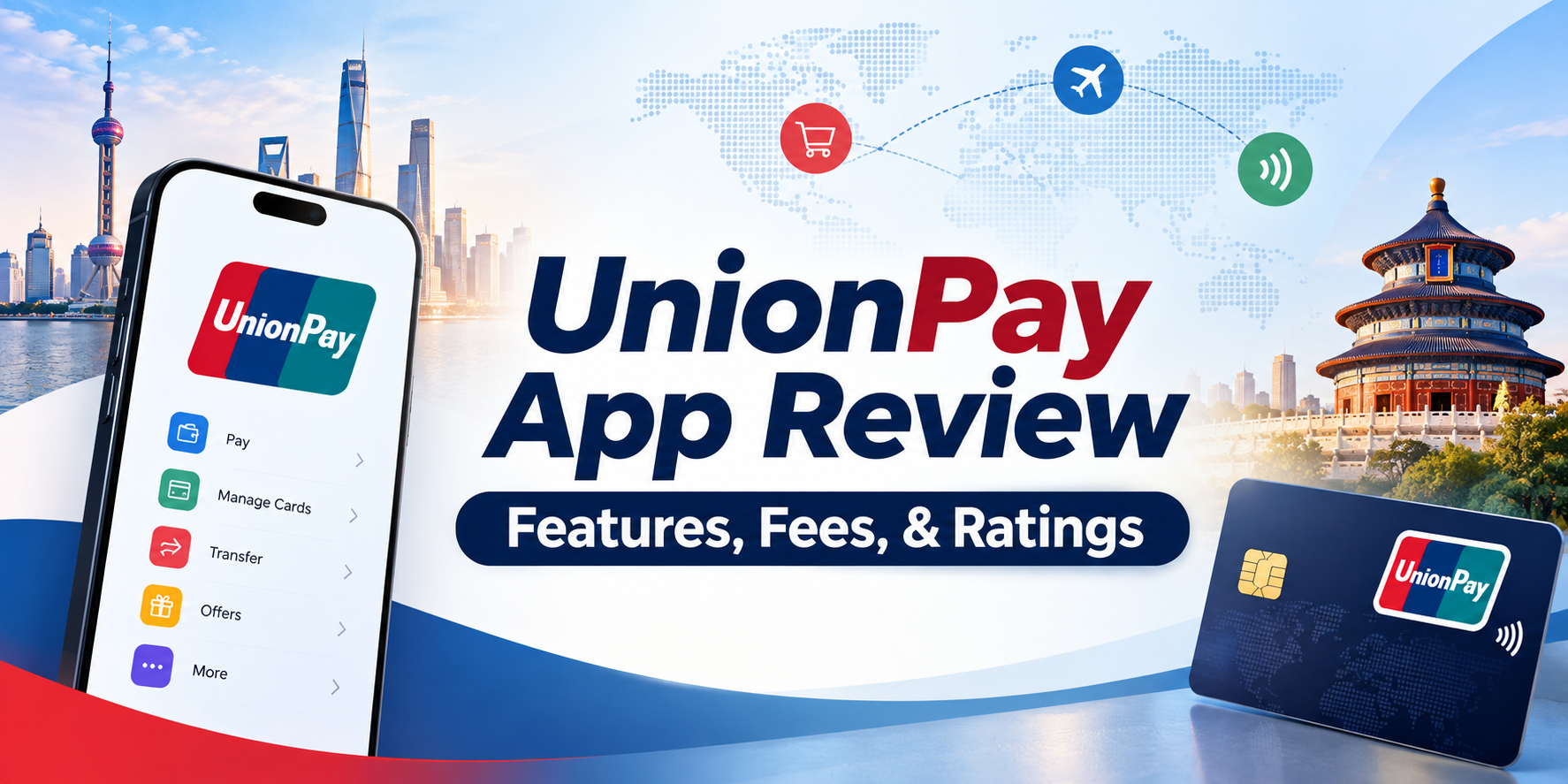
UnionPay App Review 2026: Features, Fees, & Ratings
The UnionPay App is a mobile payment and bank card management app designed around the UnionPay payment network. It is particularly useful for users who hold UnionPay cards, travel to China, or regularly make payments across markets where UnionPay has strong acceptance.
The app supports QR payments, card management, transfers, Mobile QuickPass, transit payments, and selected offers. However, the overall user experience can vary significantly by country, card type, and local availability.
Quick highlights:
- Best for: UnionPay cardholders and travelers within the UnionPay ecosystem
- Key features: QR payments, card management, transfers, contactless payments, and offers
- App fee: Generally free to download; transaction and card-related fees depend on the underlying bank or payment service
- Global reach: UnionPay cards are accepted across a large international network
- Main drawback: App usability, registration, and support can be inconsistent for some international users
Our verdict: The UnionPay App is a useful companion to the UnionPay network, especially in China and other UnionPay-friendly markets, but it may not yet offer the seamless global experience of the world’s biggest consumer wallets.
Introduction
Mobile payments have become one of the most competitive areas in global fintech. From Apple Pay and Google Pay to Alipay, WeChat Pay, and regional super apps, consumers increasingly expect their smartphones to handle everything from everyday purchases to international travel.
The UnionPay App sits in an interesting position in this ecosystem.
Unlike many standalone fintech apps, it is closely connected to one of the world’s largest payment card networks. UnionPay was established in China and has expanded its acceptance network internationally, making its cards and payment services relevant to consumers, banks, merchants, and fintech companies well beyond the Chinese market.
The UnionPay App aims to bring several financial activities into one place. Users can link and manage bank cards, make QR-based payments, access Mobile QuickPass services, complete transfers, use selected transit services, and discover discounts and privileges. In simple terms, the app is designed to make a UnionPay card more useful in a mobile-first economy.
But is the UnionPay App actually worth using in 2026?
The answer depends heavily on where you live, where you travel, and which cards you hold. For consumers already inside the UnionPay ecosystem, the app can add genuine convenience. For international users expecting a universally available digital wallet, the experience can be more complicated.
This UnionPay App review examines its features, fees, security, ratings, international usability, advantages, and limitations to help users and fintech professionals understand where it fits in today’s global payments landscape.
What Is the UnionPay App and How Does It Work?
The UnionPay App is a digital payment and card-management platform that connects users to the UnionPay banking and payments ecosystem through a single mobile application.
At its core, the app allows users to link eligible bank cards and use supported mobile payment services. Depending on the market, available services can include QR code payments, card-not-present transactions, person-to-person transfers, contactless Mobile QuickPass payments, and transit QR codes.
The basic workflow is familiar to anyone who has used a digital wallet. A user downloads the app, completes registration and identity or security requirements where applicable, links an eligible payment card, and then uses the app for supported transactions.
One of the biggest strengths of this model is that UnionPay already operates within a broad financial network. Rather than building a completely separate payment infrastructure from scratch, the app can leverage relationships between UnionPay, banks, payment institutions, merchants, and transportation providers.
For example, a user may use the app to organize multiple linked cards while also accessing mobile payment options and promotional offers. This makes the app more than just a virtual version of one bank card.
However, it is important to understand that the experience is not identical everywhere. The availability of specific features can depend on the user’s location, issuing bank, card type, device, and local payment infrastructure.
That distinction matters for international users. The UnionPay App should not automatically be viewed as a universal wallet that works exactly the same in every country. Instead, it is best understood as a mobile gateway into the broader UnionPay ecosystem.
UnionPay App Features: What Can You Do With It?
The UnionPay App combines card management with several payment options, making it a versatile tool for users whose financial activity already involves UnionPay cards or supported banking services.
Bank Card Management
The app enables users to link and manage eligible bank cards in one place. This can reduce the need to switch between multiple banking apps for basic card-related activities.
For users who hold more than one supported card, centralized management can be particularly useful. Digital wallets are increasingly becoming interfaces that sit above traditional banking products, and the UnionPay App follows this broader fintech trend.
QR Code Payments
QR payments are one of the most important features of the app. Users can pay participating merchants by scanning a QR code or displaying a payment code, depending on the transaction flow.
QR payments remain especially relevant in Asian markets, where consumers have become accustomed to using mobile codes for everything from groceries to public transport.
Mobile QuickPass
UnionPay’s Mobile QuickPass technology supports contactless payments on compatible devices and payment terminals. This provides a tap-to-pay experience similar to other NFC-based digital wallets.
For consumers, the value is simple: faster checkout without physically presenting a card.
Transfers and Other Payment Services
The app can also support transfer-related services and card-not-present transactions, subject to eligibility and market availability. This expands its role beyond physical retail payments.
Transit QR Codes
In supported locations, users can access transit payment services through QR codes. This can be especially useful for commuters and travelers navigating public transportation systems.
Offers and Privileges
UnionPay also integrates discounts and promotional offers into its ecosystem. These can include merchant deals, travel-related benefits, and other privileges available to eligible cardholders.
The feature set is broad, although the exact mix available to an individual user may vary. That is one of the app’s biggest advantages; and one of its biggest limitations.
How Much Does the UnionPay App Cost?
The UnionPay App is generally free to download, but users should not assume that every payment made through the app is completely free. The actual cost depends on the underlying card, bank, transaction type, currency, and location.
There is an important distinction between an app fee and a payment fee.
Downloading and using a mobile wallet may not involve a direct subscription charge. However, transactions connected to a bank card can still carry fees determined by the card issuer or the payment arrangement. International transactions may also involve foreign exchange conversion, cross-border processing costs, or card-specific charges.
For example, if a traveler uses a UnionPay-linked card abroad, the total cost of the transaction may depend on the exchange rate applied and the policies of the issuing bank. The UnionPay App itself may simply be the interface used to initiate or authorize the payment.
This is a common point of confusion in digital finance. A “free app” does not necessarily mean “free payments.”
Before relying on the app for international spending, users should check:
- Foreign transaction fees charged by their bank
- Currency conversion rates
- ATM withdrawal fees, if applicable
- Merchant or service-specific charges
- Fees associated with any prepaid or digital card product
The best approach is to treat the UnionPay App as a payment interface and evaluate the pricing of the underlying financial product separately.
Is the UnionPay App Safe?
The UnionPay App is built around financial-grade security and uses risk-management measures designed to protect mobile payment transactions, but users still need to follow standard digital security practices.
Security is a major consideration for any payment app because mobile wallets can store or access highly sensitive financial information.
UnionPay describes its mobile payment system as using multiple financial-grade security measures. These can involve device-related information, cardholder authentication, transaction risk analysis, and broader risk-management systems.
In practical terms, mobile payment security is not based on one single protection layer. It is usually a combination of device security, account authentication, payment credentials, risk monitoring, and transaction controls.
Users should still take responsibility for protecting their accounts. Good practices include using a strong device passcode, keeping the operating system updated, avoiding unofficial versions of the app, and never sharing verification codes or account credentials.
Privacy is another consideration. App-store disclosures indicate that data practices can differ across platforms and regions. Users should review the privacy information applicable to their version of the app, particularly if they are concerned about how personal, device, or transaction-related data may be handled.
Overall, the app offers security infrastructure expected from a major payment network, but no financial app is completely risk-free if users ignore basic security practices.
UnionPay App Ratings and User Reviews
The UnionPay App receives mixed ratings, suggesting that its core payment proposition is useful but the user experience is inconsistent across markets and user groups.
As of 2026, publicly visible ratings vary significantly by app store and region. The Google Play listing shows a relatively low overall rating, while App Store ratings also differ between regional storefronts.
That variation is worth paying attention to.
A payment app can work very well for a user whose bank, phone number, card, and location are fully supported, while creating major friction for someone trying to register from another country or use an unfamiliar international card.
Common positive themes in user feedback include:
- Convenient card and payment management
- The ability to access UnionPay’s mobile payment ecosystem
- Useful functionality for users with supported cards
Common complaints include:
- Registration difficulties
- Feature availability differences between markets
- Limited clarity around certain card or account functions
- Bugs and account-management issues
The app’s store ratings should therefore be viewed as a signal of real usability challenges rather than a definitive measure of the UnionPay network itself. UnionPay as a payment network has much broader reach than the app’s consumer ratings might suggest.
For fintech users, this is an important distinction: a strong payments infrastructure does not automatically guarantee a frictionless consumer app.
How Good Is the UnionPay App for International Travelers?
The UnionPay App can be useful for international travel, but its value is highest when travelers already have compatible UnionPay payment products and are visiting markets where UnionPay acceptance is strong.
UnionPay has built a substantial international acceptance network, covering a large number of countries and regions. The network is particularly relevant across Asia, while acceptance has also expanded in other global markets.
For travelers, the biggest advantage is potential access to an existing payment network without carrying multiple physical cards. Mobile payments can also offer greater convenience for small, everyday transactions.
The app may be especially relevant for travel to mainland China, where mobile payments are deeply integrated into daily commerce. However, international visitors should confirm eligibility and setup requirements before traveling rather than waiting until they arrive.
A smart travel strategy is to set up the app, link eligible cards, test the account, and understand transaction limits in advance.
It is also wise to carry a backup payment method.
Even in markets with broad UnionPay acceptance, not every merchant supports every mobile payment method. A physical card or alternative digital wallet can prevent an awkward “payment declined” moment when you are standing at the checkout counter.
UnionPay App vs Other Digital Wallets
The UnionPay App competes indirectly with global and regional wallets such as Apple Pay, Google Pay, Alipay, and WeChat Pay.
Its biggest differentiator is its deep connection to the UnionPay payment network and banking ecosystem.
Apple Pay and Google Pay focus heavily on making existing payment cards easier to use through compatible devices. The UnionPay App takes a similar mobile-payment approach but also emphasizes card management, QR payments, and services connected to UnionPay’s own ecosystem.
Alipay and WeChat Pay are deeply embedded in China’s digital economy and offer broader lifestyle ecosystems in addition to payments. For everyday life in China, they may provide a more extensive consumer experience.
The UnionPay App’s strength is not necessarily being the biggest super app. Its strength is being a direct gateway to a major card and payments network.
For fintech professionals, this reflects an important strategic difference. Some wallets build consumer ecosystems first and add financial services later. UnionPay starts from financial infrastructure and extends the consumer experience through mobile technology.
Pros and Cons of the UnionPay App
Pros
- Strong connection to the broader UnionPay payment network
- Supports multiple mobile payment methods
- Useful card management capabilities
- QR payments and contactless payment options
- Potentially valuable for travelers in UnionPay-friendly markets
- Access to selected offers and privileges
- Financial-grade security infrastructure
Cons
- User experience can vary considerably by country
- Registration may be challenging for some international users
- Not all features are universally available
- App-store ratings indicate usability and technical issues
- Fees are not always straightforward because costs can come from the linked bank or card
- May not replace more established local wallets in every market
The bottom line is that the app has solid infrastructure behind it, but the consumer experience is not yet equally polished for every global audience.
Who Should Use the UnionPay App?
The UnionPay App is best suited to a few specific groups.
Existing UnionPay cardholders are the most obvious users. If you already use UnionPay-issued or supported cards, the app can make them easier to manage and use on a mobile device.
Frequent travelers to China or other Asian markets may also find value in its QR and mobile payment capabilities, particularly where UnionPay is widely accepted.
Fintech professionals and payments researchers may find the app interesting as an example of how traditional card networks are adapting to the shift toward mobile-first and QR-based commerce.
However, users who want a single wallet that offers identical functionality worldwide may be disappointed. The UnionPay App is strongest when its local banking, merchant, and card ecosystem is already active around the user.
Key Takeaways
- The UnionPay App is a mobile extension of the UnionPay ecosystem, combining card management with QR, contactless, transfer, and other supported payment services.
- The app is free to download, but transaction costs can depend on linked cards, issuing banks, foreign exchange rates, and cross-border payment policies.
- UnionPay’s extensive international acceptance gives the app meaningful potential for travelers, particularly across Asian markets and other regions with established UnionPay infrastructure.
- QR payments and Mobile QuickPass are among its strongest features, reflecting the continued global shift toward fast, mobile-first payment experiences.
- User ratings are mixed, highlighting a gap between UnionPay’s large payment infrastructure and the sometimes inconsistent experience of its consumer-facing application.
- International users should verify registration, card eligibility, local availability, and transaction terms before depending on the app during an overseas trip.
- For existing UnionPay users, the app can be genuinely convenient; for everyone else, its usefulness depends heavily on geography and payment habits.
Conclusion
The UnionPay App is an important example of how established payment networks are evolving for the mobile economy.
Its biggest advantage is the infrastructure behind it. UnionPay is not a small fintech startup trying to build merchant acceptance from scratch. It is part of a major payments ecosystem with relationships across banks, merchants, and financial institutions. The app gives consumers a mobile interface for accessing that ecosystem through card management, QR payments, contactless payments, transfers, and offers.
That said, the app is not perfect.
Mixed user ratings and reports of registration or usability challenges show that a strong payment network and a great mobile app are two different things. The experience can vary significantly depending on the user’s country, device, bank, and card.
For existing UnionPay cardholders, the app is worth considering as a practical companion to their payment products. For international travelers, it can be a useful option; but it should be configured and tested before departure.
Our overall view is straightforward: the UnionPay App is most valuable when you are already connected to the UnionPay ecosystem. It offers meaningful functionality and global potential, but it may not yet be the best standalone wallet for every user.
As cross-border payments continue to become more mobile, UnionPay’s ability to improve international onboarding and user experience could determine how competitive the app becomes in the next phase of global fintech.
FAQs
1. What is the UnionPay App used for?
The UnionPay App is used to manage eligible bank cards and access supported services such as QR payments, transfers, Mobile QuickPass, transit payments, and offers.
2. Is the UnionPay App free to use?
The app is generally free to download, but payment-related charges can depend on your bank, card type, currency conversion, transaction type, and location.
3. Can foreigners use the UnionPay App?
Some international users can use the app, but eligibility and registration requirements vary. Foreign users should check supported phone numbers, cards, and local rules before setup.
4. Is UnionPay accepted internationally?
Yes. UnionPay has an extensive international acceptance network, although merchant acceptance and available services vary by country, region, and individual payment location.
5. Is the UnionPay App safe for payments?
The app uses financial-grade security and risk-management measures. Users should still protect their devices, passwords, verification codes, and other sensitive account information.
6. Is the UnionPay App better than Alipay or WeChat Pay?
It depends on your needs. UnionPay is strongest for users within its card network, while Alipay and WeChat Pay generally offer broader lifestyle ecosystems in China.