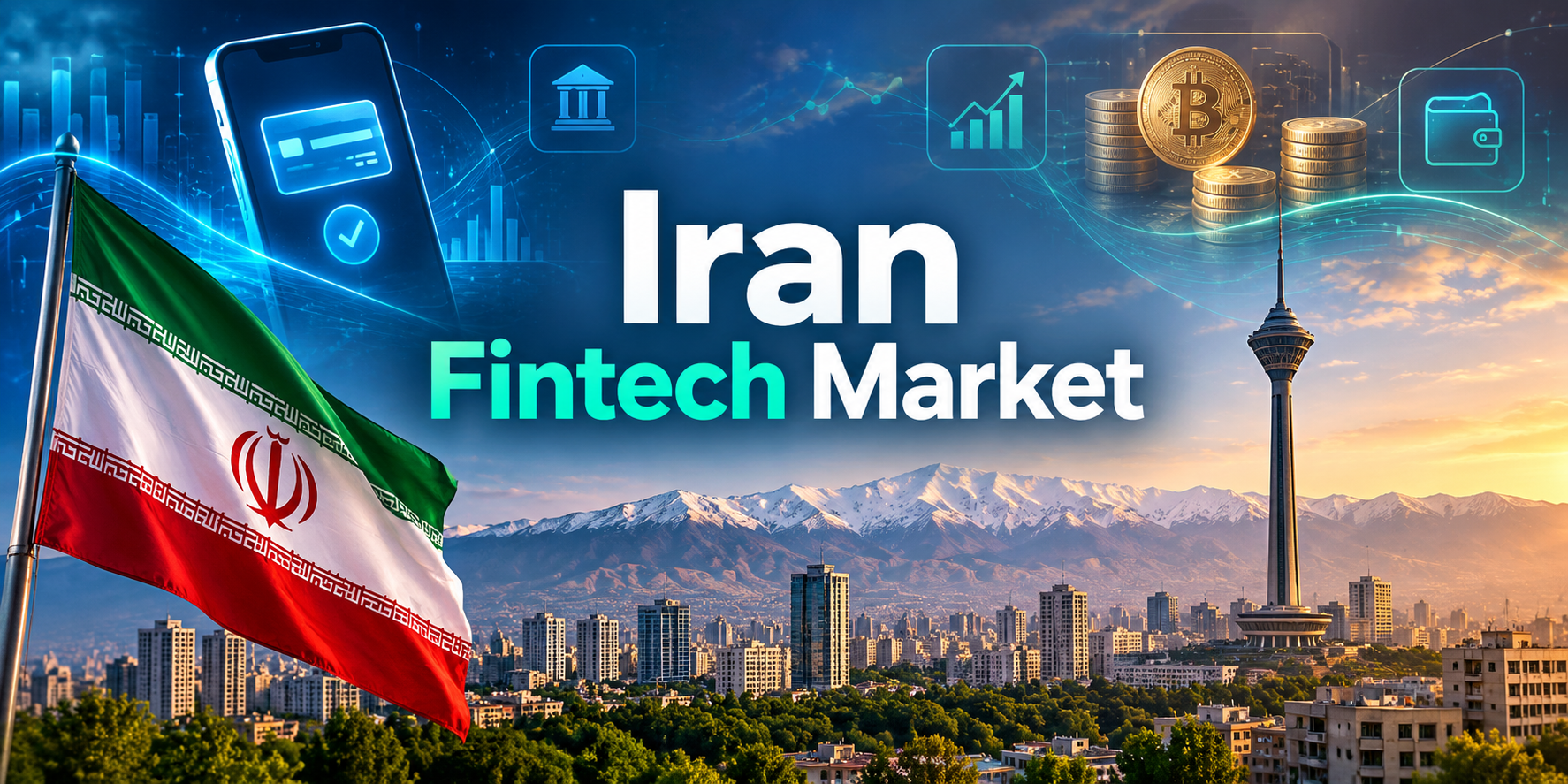
Iran Fintech Market 2026: Size, Growth, Trends, Companies and Outlook
Iran’s fintech market in 2026 is a large but unusually self-contained digital financial ecosystem. A commercial market estimate values the sector at $830 million in 2025 and projects it could reach $2.93 billion by 2034, representing a 14.58% CAGR.
Key trends shaping the market include:
- Digital payments remain the backbone of Iran’s fintech ecosystem.
- BNPL, digital lending, online gold and wealth platforms are gaining relevance.
- Iran had approximately 73.8 million internet users entering 2026.
- Cryptocurrency has become unusually important amid inflation, currency depreciation and international sanctions.
- Sanctions remain the biggest barrier separating Iranian fintech from global financial infrastructure.
Introduction: Understanding Iran’s Fintech Market in 2026
Iran is one of the more unusual fintech markets in the world.
On one hand, the country has many ingredients associated with a thriving digital finance ecosystem: a population exceeding 90 million, widespread bank-account ownership, heavy use of electronic payments, a sizable ecommerce economy and nearly 74 million internet users entering 2026. DataReportal estimates internet penetration at 79.6%, while 95% of mobile connections were capable of broadband connectivity.
On the other hand, Iranian fintech operates under conditions that bear little resemblance to markets such as the United States, United Kingdom, Singapore or neighboring UAE.
International sanctions restrict access to global payment networks, international banking relationships, foreign investment and many mainstream financial platforms. Iran has consequently developed an unusually domestic digital financial infrastructure.
Payments companies, neobanking services, lending platforms, cryptocurrency exchanges, online investment services and ecommerce payment providers have emerged around this environment.
The result is a fintech market that is digitally mature in some areas but globally disconnected in others.
For fintech professionals and investors, understanding Iran therefore requires looking beyond a single market-size figure. Payments infrastructure, consumer behavior, inflation, sanctions, cryptocurrency adoption and regulation all shape the real opportunity and risk.
Iran Fintech Market Size and Growth Outlook
Iran’s fintech market was estimated at approximately $830 million in 2025, with one commercial forecast projecting it to reach $2.93 billion by 2034 at a compound annual growth rate of 14.58% between 2026 and 2034.
That forecast provides a useful directional indicator rather than an official measure of the industry. There is no universally accepted definition of Iran’s fintech market, and estimates can include different combinations of payments, lending, investment technology, insurance technology, blockchain and financial software.
The underlying digital economy nevertheless supports continued fintech activity.
Iran had about 73.8 million internet users in late 2025, equivalent to 79.6% internet penetration. There were also approximately 151 million cellular mobile connections, reflecting widespread multi-SIM and mobile-device usage.
Ecommerce adds another layer. Research and Markets estimated Iranian B2C ecommerce at approximately $17.9 billion in 2025 and projected it to reach $21.65 billion by 2029.
Every additional online transaction creates potential demand for gateways, payment processing, digital credit, fraud prevention, merchant services and embedded financial products.
The catch? Iran’s growth path will remain heavily influenced by inflation, sanctions, regulation and geopolitical developments.
Digital Payments Are the Foundation of Iranian Fintech
If there is one segment that defines Iranian fintech, it is payments.
Iran built a highly developed domestic electronic payment ecosystem partly because international payment systems have limited or no conventional presence in the country. Instead of relying on global card networks for everyday domestic transactions, Iranian consumers and merchants primarily operate through local banking and payment infrastructure.
Shaparak, Iran’s electronic card payment network, sits at the heart of this system.
Recent Shaparak reporting illustrates just how established digital payments have become. During the Iranian financial year 1404, the number of transactions reportedly increased by around 3% year over year, while their nominal value rose approximately 48%. After adjusting for inflation, however, transaction value growth was only about 4.4%.
That distinction matters enormously.
Rapid increases in transaction values can look like explosive fintech growth when measured in nominal Iranian currency, but persistent inflation can account for much of the increase.
Digital behavior is nevertheless well established. World Bank Global Findex survey data for Iran also show extensive use of cards and mobile phones to access financial accounts.
Merchant payments, ecommerce gateways, mobile payments and payment facilitation should therefore remain core areas of Iran’s fintech economy through 2026.
Iran’s Fintech Ecosystem: Payments, Neobanks, Lending and Wealth Tech
Iranian fintech has expanded well beyond basic payment processing.
One established player is ZarinPal, which provides online payment gateways, payment links, settlement services and merchant tools. The company has become part of the infrastructure supporting Iranian online businesses and digital merchants.
Digital banking is another developing segment. blu Bank operates as a neobanking proposition connected with Saman Bank, illustrating how digital-first financial experiences are emerging through relationships with established banking institutions.
Consumer credit is becoming particularly important.
SnappPay operates in Iran’s buy now, pay later market, allowing eligible consumers to spread purchases over installments. As inflation and declining purchasing power pressure household budgets, installment-based purchasing has become increasingly relevant. The Financial Times reported in 2026 that Iranian businesses were increasingly promoting BNPL arrangements as consumers struggled with rising living costs.
Other developing fintech categories include crowdfunding, insurtech, API-based financial services, online investment platforms and digital gold.
The direction resembles global fintech development, but Iran’s products are being shaped by very different economic conditions.
Why Cryptocurrency Matters More in Iran Than in Many Markets
Cryptocurrency occupies an unusually significant position in Iran’s financial ecosystem.
Chainalysis estimated that Iran’s crypto ecosystem exceeded $7.78 billion in 2025, with activity accelerating during periods of political and economic instability.
For ordinary users, digital assets can serve several purposes: investment, trading, diversification and, in some cases, an attempted hedge against rial depreciation.
For example, Nobitex is a major Iranian cryptocurrency exchange offering rial trading pairs and access to assets including Bitcoin and USDT.
But Iran’s cryptocurrency story is much more complicated than consumer adoption.
Blockchain analytics firms and Western authorities have documented crypto use connected with sanctioned Iranian entities. Chainalysis estimated that wallets associated with Iran’s Islamic Revolutionary Guard Corps and proxy networks accounted for more than half of value received within the Iranian crypto ecosystem during Q4 2025.
In September 2026, Reuters reported on a U.S. Senate investigation into Iranian use of USDT and other crypto infrastructure. Tether said it had frozen nearly $550 million in Iran-linked USDT during 2026.
Crypto in Iran therefore sits at the intersection of consumer finance, currency protection, sanctions enforcement and geopolitical risk.
Sanctions Are Iran Fintech’s Biggest Global Constraint
Sanctions are arguably the single biggest factor distinguishing Iranian fintech from other major emerging markets.
Iranian consumers and businesses cannot participate normally in much of the global financial system. This limits conventional access to international banking relationships, payment networks and many foreign fintech services.
For foreign companies, compliance considerations are substantial.
In May 2026, the U.S. Treasury’s Office of Foreign Assets Control clarified that Iranian digital asset exchanges meet the regulatory definition of Iranian financial institutions under U.S. sanctions rules. Their property and interests in property within U.S. jurisdiction are therefore blocked under the applicable regulations.
This has two contrasting effects on Iranian fintech.
First, isolation encourages domestic innovation because local companies must build services that would otherwise be supplied by international providers.
Second, the same isolation restricts foreign investment, international expansion, cross-border interoperability and access to global technology and financial infrastructure.
That makes Iran very different from regional fintech centers such as Dubai or Riyadh, where international capital and cross-border expansion are major components of ecosystem growth.
Inflation Is Changing the Products Iranian Consumers Need
Iran’s macroeconomic environment directly influences fintech adoption.
When purchasing power falls, consumers become more interested in products that help them preserve savings, access credit or divide large purchases into smaller payments.
That helps explain rising interest in BNPL, digital lending, cryptocurrency and online gold.
The Financial Times reported in September 2026 that BNPL services were increasingly being promoted as Iranian households faced severe cost-of-living pressure.
Online gold platforms provide another example. Instead of buying an entire coin, bar or piece of jewelry, digital platforms can enable users to purchase smaller amounts of gold.
This changes the role fintech plays.
In wealthier and more economically stable markets, fintech innovation may focus primarily on convenience, lower fees and user experience. In Iran, some financial apps increasingly address a more fundamental question: how can households manage money when its purchasing power is changing rapidly?
That economic reality is likely to continue influencing product development across lending, savings and investment technology.
Iran’s Digital Rial and the Future of Central Bank Digital Currency
Iran is also experimenting with central bank digital currency.
The Central Bank of Iran moved its digital rial into a public pilot on Kish Island in 2024. The project was designed for domestic retail transactions, allowing consumers to make payments using digital rial rather than physical banknotes or traditional card transactions.
The project should not be confused with decentralized cryptocurrencies such as Bitcoin.
The digital rial is central-bank money in electronic form and remains denominated in Iran’s national currency.
Its potential value lies primarily in domestic payments, settlement efficiency and payment-system resilience.
Iran is not alone here. Central banks worldwide have researched or piloted CBDCs, although countries differ significantly in their objectives and deployment strategies.
For Iran, a digital rial could eventually complement an already highly digitized domestic payment system. However, a CBDC would not by itself remove sanctions, restore international banking access or solve inflation and exchange-rate pressures.
Those are separate economic and geopolitical challenges.
Ecommerce Will Continue Supporting Fintech Demand
Ecommerce and fintech increasingly reinforce each other.
Iran’s B2C ecommerce market was estimated at approximately $17.9 billion in 2025, with one forecast projecting it to reach around $21.65 billion by 2029.
That creates opportunities across payment gateways, merchant acquiring, installment payments, digital identity, fraud prevention and embedded finance.
World Bank Findex data also indicate strong digital payment behavior among surveyed Iranian online shoppers.
This matters because ecommerce can become a distribution channel for financial products rather than simply a customer of payment companies.
An online checkout can offer installment financing. A marketplace can embed merchant credit. Apps can integrate wallets, insurance or investment products.
That convergence between commerce and finance is already visible globally, and Iran is following the same broad direction within its domestic ecosystem.
Opportunities and Risks for Fintech Investors
Iran combines significant digital-finance demand with unusually high investment constraints.
The long-term opportunity comes from scale: a population above 90 million, high internet adoption, established electronic payments and demand for digital credit, savings and merchant services.
However, international investors must distinguish market potential from investability.
Sanctions, currency volatility, geopolitical risk, restrictions on international financial transfers, regulatory uncertainty and limited exit opportunities materially complicate investment.
This means Iran cannot be evaluated using the same framework as Saudi Arabia, the UAE or other regional fintech markets.
Domestic demand may be substantial even when foreign participation remains difficult.
For stock-market investors specifically, another limitation is that many prominent Iranian fintech businesses are privately held or operate within larger domestic groups. Direct exposure through internationally accessible listed equities is therefore limited.
Any investment involving Iran also requires appropriate sanctions and legal compliance analysis for the investor’s jurisdiction.
Key Takeaways
- Iran’s fintech market was estimated at $830 million in 2025, with one commercial forecast projecting a 14.58% CAGR through 2034.
- Digital payments form the backbone of Iranian fintech, supported by an established domestic card network and widespread consumer adoption of electronic transactions.
- Internet adoption provides a substantial addressable audience, with approximately 73.8 million internet users and 79.6% penetration entering 2026.
- BNPL and digital lending are becoming increasingly relevant as inflation and declining household purchasing power increase demand for flexible consumer financing.
- Cryptocurrency plays an unusually prominent role, serving consumer investment demand while also attracting intense scrutiny over sanctions-related and state-linked activity.
- International sanctions remain the sector’s biggest structural constraint, limiting foreign investment, cross-border payments and integration with mainstream global financial infrastructure.
- Iran’s fintech opportunity is primarily domestically driven, making its growth model fundamentally different from internationally connected Middle Eastern fintech hubs such as Dubai and Riyadh.
Conclusion: What Is the Outlook for Iran’s Fintech Market?
Iran’s fintech market in 2026 presents a paradox.
The country has many of the foundations required for a major digital finance ecosystem: more than 90 million people, approximately 74 million internet users, extensive electronic-payment usage, growing ecommerce and an established community of local financial technology providers.
A commercial estimate placing the market at $830 million in 2025 and forecasting $2.93 billion by 2034 suggests significant potential, although such projections should be treated cautiously given Iran’s economic and geopolitical uncertainty.
Payments will likely remain the industry’s foundation, while BNPL, lending, digital wealth products, crypto and embedded finance provide additional growth areas.
But the Iranian fintech story cannot be separated from the wider economy.
Inflation influences consumer behavior. Rial depreciation encourages interest in alternative stores of value. Sanctions stimulate domestic financial innovation while simultaneously restricting international integration.
That makes Iran neither a conventional emerging fintech market nor a straightforward investment opportunity.
Instead, it is a large, highly localized digital financial ecosystem evolving under exceptional constraints. For global fintech professionals and investors, that combination is precisely what makes the Iran fintech market worth watching.
FAQs About the Iran Fintech Market
1. How big is the Iran fintech market?
One commercial estimate valued Iran’s fintech market at $830 million in 2025 and forecasts it to reach approximately $2.93 billion by 2034, representing 14.58% CAGR.
2. What are the biggest fintech trends in Iran in 2026?
Major trends include digital payments, BNPL and digital lending, cryptocurrency adoption, online gold investing, ecommerce-linked financial services, neobanking and continued experimentation with the digital rial.
3. What are some fintech companies in Iran?
Iran’s ecosystem includes payment provider ZarinPal, BNPL provider SnappPay, digital banking service blu Bank and cryptocurrency exchange Nobitex, among numerous financial technology businesses.
4. Is cryptocurrency legal in Iran?
Iran permits some cryptocurrency activities but maintains significant regulatory controls, particularly around exchanges, payments and mining. Rules can change, while international sanctions create additional restrictions for foreign counterparties.
5. Does Iran have a central bank digital currency?
Yes. Iran has developed the digital rial, a central bank digital currency designed primarily for domestic retail payments, with a public pilot launched on Kish Island in 2024.
6. Can foreign investors invest in Iranian fintech companies?
Foreign investment faces substantial practical and legal barriers, including international sanctions, banking restrictions, currency risks and regulatory requirements. Investors should obtain jurisdiction-specific legal and sanctions-compliance advice before considering exposure.