Italy Fintech Market 2026: Size, Trends, and Growth Outlook
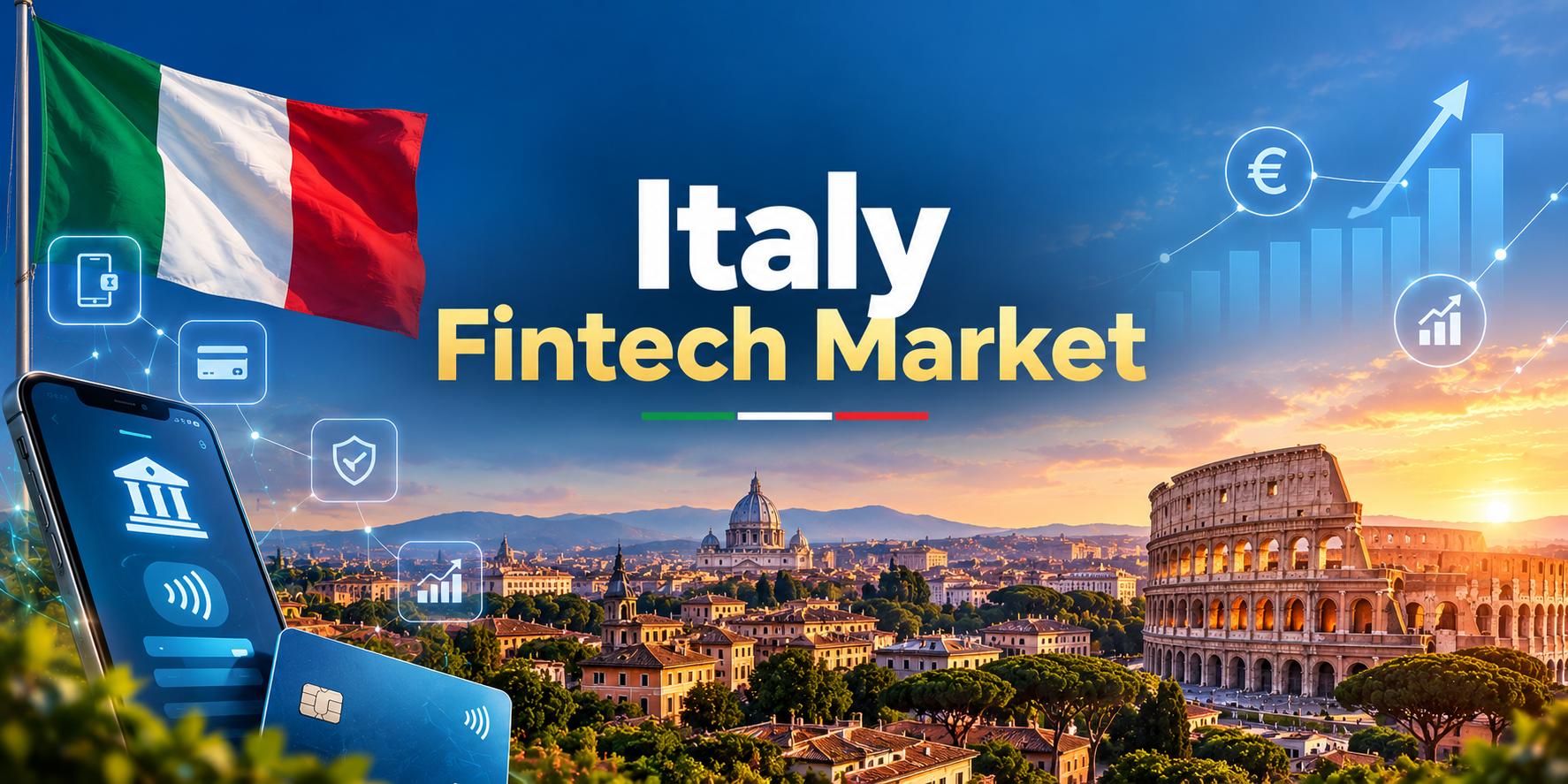
Italy’s fintech market is evolving into an important part of Europe’s digital financial services ecosystem, driven by digital payments, open banking, embedded finance, artificial intelligence, and financial technology innovation.
Key highlights include:
- Market size: Italy has a diverse fintech ecosystem spanning hundreds of startups and established financial technology providers.
- Digital payments: Contactless transactions, mobile wallets, and instant payments are reshaping consumer behavior.
- Leading companies: Satispay, Nexi, Scalapay, Fabrick, and Tinaba are prominent market participants.
- Investment: Venture capital, banking partnerships, and consolidation are influencing industry development.
- Growth outlook: AI-powered finance, SME lending, and embedded financial services present opportunities through 2030.
Italy offers significant fintech potential, although regulatory complexity, funding constraints, and competition remain important challenges.
Introduction
Italy’s financial technology industry is undergoing a transformation as consumers, businesses, and financial institutions increasingly embrace digital financial services.
Traditionally associated with a bank-centered financial system and widespread cash usage, Italy is becoming a more digitally connected financial market.
Mobile payments, digital banking applications, embedded finance, and alternative lending platforms are changing how Italians manage money, make purchases, and access financial services.
Milan has emerged as the country’s primary fintech hub, attracting startups, financial institutions, venture capital investors, and international technology companies. Rome, Turin, and other cities also contribute to the broader innovation ecosystem.
Italy’s fintech development is closely connected to European Union initiatives promoting digital payments, financial interoperability, cybersecurity, and regulated digital assets.
The country’s established banking institutions, including Intesa Sanpaolo and UniCredit, are investing in digital transformation while collaborating with technology providers.
At the same time, companies such as Satispay, Nexi, Scalapay, and Fabrick are introducing new approaches to payments, consumer financing, and financial infrastructure.
For fintech professionals and investors, Italy represents an interesting combination of established financial institutions and emerging technology-driven business models.
However, growth opportunities come with challenges, including regulatory compliance, fragmented business adoption, cybersecurity threats, and increasing competition.
Understanding the Italy fintech market in 2026 requires examining its size, leading companies, digital payment trends, investment environment, and outlook through 2030.
Italy Fintech Market Size and Growth in 2026
The Italy fintech market in 2026 is a growing European financial technology ecosystem encompassing digital payments, banking technology, embedded finance, alternative lending, wealth management, and insurtech. Although a single authoritative estimate of total fintech industry revenue is not consistently available, digital payment activity and financial technology adoption indicate continued market development.
Italy’s fintech ecosystem includes independent startups, scaleups, technology subsidiaries of established financial institutions, and international providers serving Italian customers.
However, fintech market size can be measured in different ways.
Some industry reports focus on fintech company revenues, while others examine digital payment transaction values, venture capital funding, or the number of active startups.
These indicators should not be treated as interchangeable.
For example, the total value of card transactions represents payment activity rather than revenue earned by fintech companies.
According to the Innovative Payments Observatory at Politecnico di Milano, digital payments in Italy reached approximately €481 billion in 2024, representing growth of about 8.5% compared with 2023.
This provides a useful historical benchmark for understanding the country’s transition toward electronic payments.
The same research highlighted increasing adoption of smartphone and wearable payments.
For 2026, the strongest indicators of fintech development include rising demand for digital payment infrastructure, growing business financial automation, and increased integration between traditional banking and technology platforms.
Looking ahead, Italy’s fintech market could benefit from European payment modernization, AI adoption, and growing demand for digital financial services among small and medium-sized enterprises.
Key Drivers of Italy’s Fintech Market Growth
Several economic, technological, and regulatory factors are accelerating fintech adoption across Italy.
1. Rising Digital Payment Adoption
Italian consumers are increasingly choosing cards, mobile wallets, and contactless payments over cash.
According to Politecnico di Milano research published in 2026, electronic payments accounted for approximately 45% of Italian consumer spending in 2025, compared with 38% for cash.
This shift creates opportunities for payment processors, digital wallet providers, and merchants offering seamless checkout experiences.
2. Digital Transformation of Small Businesses
Small and medium-sized enterprises form a critical part of Italy’s economy.
Many businesses are seeking digital solutions for invoicing, accounting, cash flow management, payments, and financing.
Fintech companies can address these needs through integrated platforms that reduce administrative work and improve financial visibility.
3. Banking and Fintech Partnerships
Established banks increasingly collaborate with fintech companies to accelerate innovation.
These partnerships enable banks to modernize their services while allowing fintech providers to access established distribution networks.
For example, banking-as-a-service platforms can help businesses integrate financial products without developing banking infrastructure independently.
4. European Financial Integration
Italy benefits from the European Union’s harmonized financial regulations and payment infrastructure.
Initiatives supporting instant euro payments, open banking, and digital identity could simplify cross-border transactions and expand fintech market opportunities.
5. Artificial Intelligence and Automation
AI-powered technologies are creating new possibilities for fraud prevention, credit assessment, insurance underwriting, and financial operations.
For financial institutions, AI can improve efficiency. For consumers, it can support faster decisions and more personalized services.
Together, these factors suggest that Italy’s fintech growth is increasingly connected to the modernization of its wider financial system.
Top Fintech Companies in Italy in 2026
Italy is home to several prominent financial technology companies operating across payments, lending, digital banking, and financial infrastructure.
1. Satispay
Satispay is one of Italy’s best-known fintech companies, offering mobile payment services for consumers and merchants.
Its application allows users to make payments, transfer money, and access participating merchant services.
The company represents Italy’s growing demand for payment solutions that simplify everyday transactions.
2. Nexi
Nexi is a major European payment technology provider headquartered in Italy.
Its services include merchant acquiring, digital payment acceptance, card processing, and payment infrastructure.
Unlike many privately held fintech startups, Nexi is publicly traded, making it relevant to investors seeking exposure to European payment technology.
3. Scalapay
Scalapay specializes in buy now, pay later (BNPL) services.
Its platform allows eligible consumers to divide purchases into installments while helping participating merchants offer flexible checkout options.
BNPL remains an important segment of consumer finance, although credit risk and regulation require careful management.
4. Fabrick
Fabrick provides open finance and embedded payment infrastructure.
Its technology helps businesses integrate payment services, financial connectivity, and banking-related capabilities into digital products.
The company illustrates the growing importance of financial infrastructure providers within Italy’s fintech ecosystem.
5. Tinaba
Tinaba offers digital financial services through a mobile application, including payments and banking-related features.
Its services are designed to simplify everyday financial management for consumers.
6. Young Platform
Young Platform operates in the digital asset industry, offering cryptocurrency-related services.
It represents Italy’s participation in Europe’s evolving digital asset ecosystem, where regulatory authorization and consumer protection are increasingly important.
7. Moneyfarm
Moneyfarm provides digital wealth management and investment services.
Its platform combines technology-driven portfolio management with investment products designed for different financial goals and risk profiles.
8. Credimi
Credimi focuses on technology-enabled business financing.
Its services illustrate how fintech can help small and medium-sized enterprises access financing solutions outside conventional lending processes.
These companies operate across different segments and should not be interpreted as a ranking by revenue, valuation, or market share.
For consumers, the best fintech platform depends on pricing, functionality, eligibility, and regulatory protection.
For investors, understanding each company’s business model is essential before evaluating its commercial potential.
Major Fintech Trends in Italy in 2026
Italy’s fintech industry is moving beyond basic digital payments toward integrated financial services.
1. Mobile Wallets and Contactless Payments
Mobile payment adoption continues to expand.
Politecnico di Milano’s Innovative Payments Observatory reported that smartphone and wearable payments reached approximately €84.9 billion in 2025, representing growth of around 46% compared with the previous year.
These technologies are becoming increasingly familiar across retail stores, restaurants, transportation, and e-commerce.
2. Embedded Finance
Embedded finance allows businesses to integrate payments, lending, or other financial products directly into their applications.
For example, an e-commerce platform could offer financing at checkout without redirecting customers to a separate banking application.
Companies such as Fabrick demonstrate how financial infrastructure providers can support this model.
3. Buy Now, Pay Later
BNPL continues to attract attention from consumers and online merchants.
Politecnico di Milano reported approximately €9.9 billion in Italian BNPL transactions during 2025, with 17% of Italians having used the service.
However, consumer credit regulation and responsible lending practices remain important considerations.
4. Open Banking and Account-to-Account Payments
Open banking enables authorized financial service providers to access customer-permitted banking data.
This can support personal finance applications, financial management tools, and alternative payment experiences.
Instant euro payments are also creating opportunities for faster account-to-account transactions.
5. AI-Powered Financial Services
Artificial intelligence is increasingly being applied to fraud detection, customer service, credit analysis, and financial operations.
For fintech providers, the challenge is demonstrating measurable improvements in efficiency, accuracy, and customer experience.
6. Digital Assets and Tokenization
European regulation is encouraging the development of more structured digital asset services.
Tokenization, regulated cryptocurrency services, and blockchain-based financial infrastructure could create additional opportunities, although commercial adoption remains uncertain.
Italy Fintech Investment and Funding Trends
Italy’s fintech investment landscape is entering a more mature phase, with investors paying greater attention to financial sustainability and commercial performance.
According to the Fintech & Insurtech Observatory at Politecnico di Milano, Italy had 485 active fintech and insurtech startups at the end of 2025, compared with 596 in 2024.
The decline reflected business closures, consolidation, and mergers and acquisitions rather than simply reduced innovation.
During the first ten months of 2025, these companies raised approximately €202 million through equity financing and convertible instruments, compared with €250 million during 2024.
The figures highlight the challenges facing early-stage fintech businesses seeking capital.
However, the same research identified improving revenue performance among existing companies.
Median projected annual revenue increased to approximately €700,000 in 2025, compared with €500,000 in 2024.
For investors, this suggests a market increasingly focused on operational maturity.
Investment opportunities include payments infrastructure, enterprise financial software, SME financing, cybersecurity, and regulatory technology.
Rather than relying exclusively on startup valuations, investors should evaluate revenue quality, customer retention, profitability, and regulatory exposure.
Italy Fintech Regulations and Government Policies
Italy’s fintech market operates under national financial supervision and European Union regulations.
The Bank of Italy supervises banking institutions, payment service providers, and other regulated financial activities.
CONSOB, Italy’s financial markets regulator, oversees relevant investment services, securities markets, and investor protection requirements.
Important regulatory developments include:
Markets in Crypto-Assets Regulation (MiCA): Establishes harmonized requirements for crypto-asset services and certain digital assets across the European Union.
Digital Operational Resilience Act (DORA): Strengthens cybersecurity, technology risk management, and operational resilience requirements for covered financial institutions.
General Data Protection Regulation (GDPR): Governs personal data processing and privacy protection.
Instant Payments Regulation: Introduces requirements designed to improve the availability, affordability, and security of instant euro transfers.
In 2026, the Bank of Italy issued updated supervisory provisions for payment institutions and electronic money institutions.
These regulatory developments can increase compliance costs but also strengthen market confidence.
For fintech companies expanding internationally, understanding licensing requirements and cross-border obligations is essential.
Challenges Facing Italy’s Fintech Industry
Despite growing digital adoption, Italy’s fintech industry faces several structural challenges.
Limited startup funding: Access to growth capital remains challenging, particularly for early-stage companies seeking to scale internationally.
Fragmented SME adoption: Smaller businesses vary considerably in their willingness and ability to adopt new financial technologies.
Regulatory complexity: Compliance with banking, payment, cybersecurity, and data protection requirements can increase operating costs.
Cybersecurity threats: Digital payment fraud, identity theft, and sophisticated cyberattacks require continuous investment in security.
Competition: Italian fintech companies face pressure from established banks, European fintech providers, and global technology platforms.
Profitability: Customer acquisition costs, transaction margins, and operational expenses can make sustainable growth difficult.
Addressing these challenges will be essential for building a competitive fintech ecosystem capable of expanding beyond Italy.
Italy Fintech Market Forecast: 2027–2030
Italy’s fintech market is positioned for continued development through 2030, supported by digital payment adoption, financial automation, and European financial infrastructure modernization.
Instant payments and mobile wallets could become more deeply integrated into everyday consumer and business transactions.
Embedded finance may expand as retailers, software providers, and digital platforms integrate financial services into their products.
AI-powered fraud prevention, credit assessment, and financial administration could also create opportunities.
Meanwhile, fintech consolidation may continue as established companies acquire specialized technology providers.
However, growth is unlikely to be uniform across segments.
Funding availability, regulatory developments, economic conditions, and competition will influence commercial performance.
The most useful indicators to monitor include digital payment volumes, fintech revenues, active users, profitability, investment activity, and cross-border expansion.
Key Takeaways
1. Italy’s fintech ecosystem is maturing: The country had 485 active fintech and insurtech startups at the end of 2025, reflecting consolidation and competitive pressures.
2. Digital payments are increasingly mainstream: Electronic payment methods accounted for approximately 45% of Italian consumer spending in 2025, highlighting changing financial behavior.
3. Leading fintech companies span multiple segments: Satispay, Nexi, Scalapay, Fabrick, and Moneyfarm demonstrate Italy’s capabilities across payments, lending, financial infrastructure, and wealth management.
4. Fintech investment is becoming more selective: Funding challenges are encouraging startups to prioritize profitability, customer retention, operational efficiency, and sustainable business models.
5. Embedded finance presents significant opportunities: Banking APIs, integrated payments, and financial automation could help Italian businesses deliver more seamless financial experiences.
6. European regulations are shaping innovation: MiCA, DORA, GDPR, and instant payment requirements influence compliance, cybersecurity, digital asset services, and financial market competition.
7. Long-term growth depends on successful scaling: Italy’s fintech outlook through 2030 will be influenced by investment availability, international expansion, technology adoption, and regulatory stability.
Conclusion
The Italy fintech market in 2026 reflects a financial technology ecosystem transitioning from rapid startup expansion toward greater maturity, consolidation, and sustainable innovation.
Digital payments, mobile wallets, embedded finance, and AI-powered financial services are reshaping how Italian consumers and businesses interact with financial institutions.
The country’s established banking infrastructure, strong SME sector, and integration with the European financial system create meaningful opportunities for technology-driven financial services.
Companies such as Satispay, Nexi, Scalapay, and Fabrick demonstrate the diversity of Italy’s fintech ecosystem, from consumer payments to enterprise financial infrastructure.
However, the market also faces challenges.
Funding constraints, regulatory complexity, competition, and profitability pressures require fintech businesses to demonstrate measurable value rather than relying solely on innovation-driven growth narratives.
For consumers, continued fintech development could mean faster payments, easier access to financial products, and more convenient money management.
For investors, opportunities exist across payments, financial software, SME financing, and regulatory technology, although company fundamentals remain critical.
Looking toward 2030, Italy has the potential to strengthen its position within Europe’s fintech landscape.
Ultimately, Italy’s fintech success will depend on its ability to combine technological innovation with financial sustainability, consumer trust, and international competitiveness.
FAQs About the Italy Fintech Market
1. What is the size of Italy’s fintech market in 2026?
Italy had 485 active fintech and insurtech startups at the end of 2025. A comprehensive, standardized estimate of total fintech market revenue remains unavailable.
2. Is fintech growing in Italy?
Yes. Digital payment adoption and financial technology usage are expanding. However, startup consolidation and selective investment indicate that growth varies across fintech segments.
3. What are the top fintech companies in Italy?
Prominent fintech companies include Satispay, Nexi, Scalapay, Fabrick, Tinaba, Moneyfarm, Young Platform, and Credimi, operating across payments, lending, banking technology, and investment services.
4. How much investment does Italy’s fintech industry attract?
Italian fintech and insurtech startups raised approximately €202 million during the first ten months of 2025, reflecting selective investment and increased focus on financial sustainability.
5. What are the biggest fintech trends in Italy?
Major trends include mobile payments, embedded finance, instant euro transfers, open banking, AI-powered financial services, buy now pay later, and regulated digital assets.
6. What is the future of fintech in Italy?
Italy’s fintech industry could expand through 2030 as digital payments, embedded finance, and financial automation develop, although funding, competition, and regulation remain important factors.