
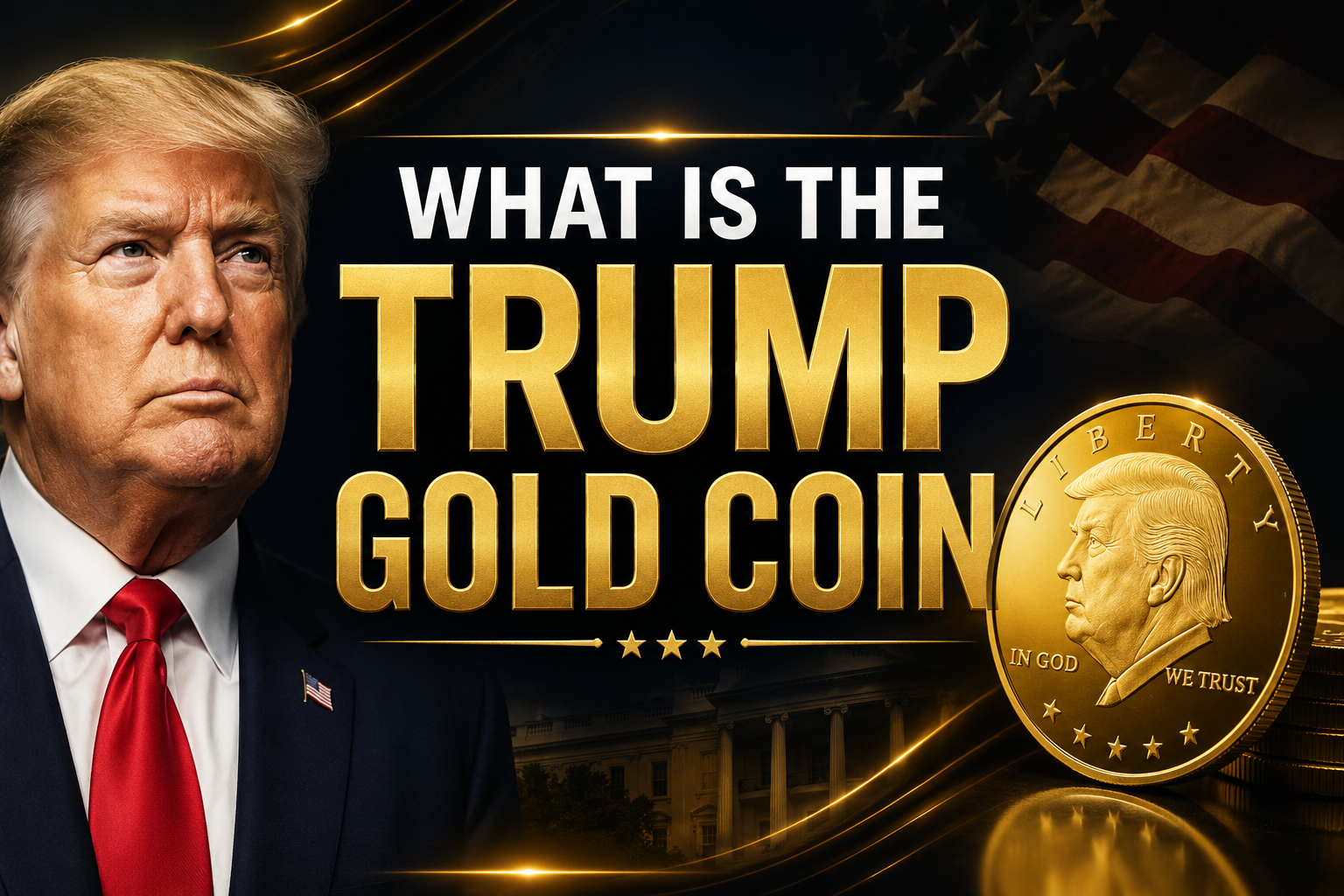
The Trump Gold Coin refers to the new U.S. Mint coins featuring President Donald J. Trump as part of America’s 250th-anniversary, or Semiquincentennial, program. However, there are two different products that people may mean by the term.
- The Trump $1 coin is a genuine U.S. Mint legal-tender coin with a gold-colored finish, but it does not contain gold.
- Its composition is primarily copper, with zinc, manganese and nickel, and its face value is $1.
- The U.S. Mint began selling rolls and bags of the $1 coin on September 2, 2026.
- A separate 24-karat, one-ounce gold proof coin featuring Trump is also part of the 2026 program.
- The 24K gold coin is a genuine precious-metal product and is fundamentally different from the $1 coin.
- The Trump $1 coin is primarily a collectible and historic coin, not a gold investment.
Introduction
The Trump Gold Coin has become a hot topic among collectors, investors, political observers and fintech users because it combines several things that rarely appear in the same financial conversation: U.S. currency, precious metals, collectibles, politics and the country’s 250th anniversary.
But there is a major source of confusion.
When people search for “Trump Gold Coin,” they may be referring to the new President Donald J. Trump $1 Coin, which has a gold-colored appearance but contains no gold. They may also be referring to a separate 24-karat, one-ounce gold proof coin being produced as part of the U.S. Mint’s 2026 Semiquincentennial program.
The distinction matters for anyone considering buying one.
The $1 Trump coin is made from a copper-based alloy and has a face value of one dollar. The U.S. Mint says it is being released into circulation and sold in bags and rolls. The Mint’s listed prices are $61 for a 25-coin roll and $154.50 for a 100-coin bag.
The separate 24K gold proof coin is an actual precious-metal product. The U.S. Mint’s August 2026 Federal Register notice identifies it as a 2026 Semiquincentennial President Donald J. Trump 24K One-Ounce Gold Proof Coin, although its retail price was still listed as TBD in that notice.
For investors, the key takeaway is simple: do not assume that a “Trump Gold Coin” is made of gold simply because it looks golden or is described that way online.
What Is the Trump Gold Coin?
The Trump Gold Coin is most commonly used to describe the 2026 President Donald J. Trump $1 Coin, a U.S. Mint-issued coin created for America’s 250th anniversary. Despite its gold-like appearance, the $1 coin is not made of gold; it is a copper-based alloy with a golden-colored finish.
The coin is part of the U.S. Mint’s 2026 Semiquincentennial program, which introduced special one-year designs across several denominations. The Trump $1 coin carries Trump’s portrait on the obverse and the Presidential Seal on the reverse. The obverse includes “LIBERTY,” “IN GOD WE TRUST,” and “1776 ~ 2026,” while the reverse includes “UNITED STATES OF AMERICA,” “ONE DOLLAR,” and “250.”
The coin’s official specifications make the distinction especially clear. It weighs 8.10 grams, measures 26.49 millimeters in diameter and is composed of 6% zinc, 3.5% manganese, 2% nickel and a copper balance. It is minted at the Philadelphia Mint.
The U.S. Mint began selling the coin in rolls and bags on September 2, 2026. A 25-coin roll costs $61, while a 100-coin bag costs $154.50.
That means buyers are paying more than the coins’ face value when purchasing directly from the Mint. The premium reflects packaging, distribution and collector demand—not the presence of precious metal.
Is the Trump $1 Coin Actually Made of Gold?
No. The Trump $1 coin is not made of gold and should not be treated as a gold bullion coin. Its golden appearance comes from its metallic composition and finish, similar to other U.S. “golden dollar” coins.
This distinction is particularly important because the term “gold coin” can mean two very different things in the collectibles and investment markets.
A true gold coin contains a measurable quantity of gold, usually specified by purity and weight. For example, a 24-karat, one-ounce gold coin contains 99.99% fine gold and derives a substantial portion of its value from the underlying metal.
The Trump $1 coin does not work that way.
According to the U.S. Mint, its composition is 6% zinc, 3.5% manganese, 2% nickel and the balance copper. Its weight is 8.10 grams.
The Mint itself explains that U.S. “golden dollar” coins are not actually gold. The golden appearance is produced by the coin’s metal composition rather than precious-metal content.
For investors, that means the Trump $1 coin does not provide direct exposure to the gold price.
If the international gold price rises, the intrinsic metal value of the Trump $1 coin does not rise in the same way that a one-ounce gold bullion coin would.
Instead, its potential value comes from collectibility, scarcity, historical significance and market demand.
That makes it closer to a numismatic collectible than a conventional gold investment.
Trump $1 Coin vs. Trump 24K Gold Coin: What’s the Difference?
The biggest source of confusion is that the 2026 U.S. Mint program includes both a Trump $1 coin and a separate 24-karat gold proof coin.
They should be viewed as completely different products.
| Feature | Trump $1 Coin | Trump 24K Gold Proof Coin |
| Issuer | U.S. Mint | U.S. Mint |
| Metal | Copper-based alloy | 24K gold |
| Gold content | None | One troy ounce |
| Face value | $1 | Numismatic denomination |
| Purpose | Circulating/collectible coin | Precious-metal collectible |
| 2026 program | Semiquincentennial | Semiquincentennial |
| Mint | Philadelphia | U.S. Mint precious-metal program |
| Investment exposure to gold | No | Yes |
| Retail price | $61 roll / $154.50 bag | TBD in August 2026 notice |
The U.S. Mint officially describes the Trump $1 coin as a circulating coin. Its current product information gives the same alloy composition as above and says it is available in bags and rolls.
Meanwhile, the Federal Register identifies the separate product as the “2026 Semiquincentennial President Donald J. Trump 24K One-Ounce Gold Proof Coin.” Its retail price was still listed as “TBD” in the August 12, 2026 pricing notice.
This creates an important rule for buyers:
If you’re buying the Trump $1 coin, you’re buying a historic U.S. coin with collector potential. If you’re buying the 24K coin, you’re buying a precious-metal collectible whose value is linked to gold as well as collector demand.
That difference should be reflected in how investors evaluate the two products.
How Much Does the Trump Gold Coin Cost?
The answer depends on which Trump coin you mean.
For the Trump $1 coin, the U.S. Mint has set the price at $61 for a 25-coin roll and $154.50 for a 100-coin bag. That works out to approximately $2.44 per coin for the roll and about $1.55 per coin for the bag.
Those prices are above the coins’ $1 face value.
That does not mean the coin contains $1.55 or $2.44 worth of metal. Rather, the difference represents the Mint’s retail pricing for rolls and bags of a newly issued collectible item.
The Mint has also produced 250,000 Trump $1 coins with a special “July 4th” privy mark. These coins were struck on July 4 at the Philadelphia Mint and were randomly included in the rolls and bags.
The separate 24K one-ounce Trump gold proof coin is different. As of the U.S. Mint’s August 2026 Federal Register notice, its retail price was still listed as TBD. The Mint notes that precious-metal product pricing can change based on the London Bullion Market Association gold-price average.
Therefore, buyers should be careful with online listings that use the phrase “Trump Gold Coin” without clearly stating the product’s weight, purity, issuer and denomination.
Why Is the Trump Coin Historically Significant?
The Trump $1 coin is significant because it places the image of a sitting U.S. president on a U.S. coin, while also forming part of the country’s 250th-anniversary celebrations.
The U.S. Mint says the coin was authorized under 31 U.S.C. §5112(y)(1)(C) and the Circulating Collectible Coin Redesign Act of 2020, which permits a new $1 coin for one year beginning in 2026 to celebrate the Semiquincentennial.
The decision has nevertheless generated controversy.
A separate 24-karat gold commemorative coin featuring Trump was approved by the U.S. Commission of Fine Arts in March 2026. Reuters reported that the proposed gold coin was part of the U.S. Mint’s broader 250th-anniversary program and drew criticism because of the longstanding U.S. tradition against depicting living presidents on national currency.
The distinction between the $1 coin and the non-circulating gold proof coin is important in understanding the legal and historical debate.
The $1 coin is explicitly tied to the 2020 legislation cited by the Mint. The 24K gold product has a different numismatic status and legal basis.
For collectors, that controversy could eventually become part of the coin’s historical narrative. But controversy alone does not guarantee appreciation in value.
Is the Trump Gold Coin a Good Investment?
The Trump $1 coin should not be considered a conventional gold investment because it contains no gold.
Its potential investment value depends on collector demand, scarcity, condition, packaging, provenance and future interest in the coin.
The 250,000 coins with the special July 4th privy mark could attract additional collector interest because they have a specific production distinction. However, a special marking does not automatically mean a coin will become valuable. Collectors typically consider factors such as mintage, survival rate, condition, certification and long-term demand.
The 24K Trump gold proof coin is a different proposition because it contains one ounce of gold. Its value can therefore be influenced by the gold market as well as numismatic demand.
For stock investors and fintech professionals, the broader lesson is familiar: an asset’s label is not the same as its underlying economic exposure.
A product marketed as a “gold coin” might provide exposure to gold, collectible demand, political memorabilia—or some combination of all three.
Before buying, investors should identify the exact product and determine what actually drives its value.
Where Can You Buy the Trump $1 Coin?
The safest place to buy the official Trump $1 coin is the United States Mint.
The Mint says the coin is available for purchase in bags and rolls through its official website. Its product page lists a $61 price for the 25-coin roll and $154.50 for the 100-coin bag.
This matters because the popularity of the Trump name has already created a broad market for privately produced Trump-themed coins and medals.
Not every product carrying Trump’s name is a U.S. government coin.
Private companies sell commemorative products featuring Trump, including silver and gold-plated collectibles. These can be legitimate privately issued products, but they should not be confused with coins produced by the U.S. Mint.
Buyers should check:
- The issuer
- Metal composition
- Weight
- Purity
- Face value
- Mint mark
- Certificate of authenticity, where applicable
- Official product number
- Whether the product appears on the U.S. Mint’s website
The U.S. Mint’s official product page is the best reference point for identifying the government-issued $1 coin.
Trump Gold Coin vs. Trump Crypto Coin
Another important distinction is between the physical Trump coins and Trump-related cryptocurrency.
The physical Trump $1 coin is issued by the U.S. government through the U.S. Mint. It has a legal-tender denomination of $1 and is part of the 2026 Semiquincentennial coin program.
Cryptocurrency products associated with the Trump brand are entirely different financial instruments.
The most prominent example is the $TRUMP memecoin, launched in January 2025. It operates on a blockchain rather than through the U.S. Mint and does not represent ownership of the Trump $1 coin or the 24K Trump gold coin.
This distinction is critical for fintech users.
A physical commemorative coin has characteristics such as metal composition, weight, minting, denomination and condition. A cryptocurrency has characteristics such as blockchain, token supply, liquidity, market capitalization, exchange availability and wallet custody.
The word “coin” does not make the two assets equivalent.
Similarly, the term “gold” does not automatically mean an asset is backed by physical gold.
Anyone evaluating a Trump-branded financial product should first establish whether it is a government-issued coin, precious-metal collectible, private commemorative product or cryptocurrency.
How Does the Trump Gold Coin Compare With Traditional Gold Investments?
Traditional gold investments and the Trump $1 coin have fundamentally different risk and return characteristics.
An investor buying physical gold typically cares about the spot price of gold, purity, weight, dealer premiums, storage and liquidity. Gold ETFs and other financial products provide alternative forms of exposure to gold prices.
The Trump $1 coin does not offer that exposure.
Its value is primarily connected to its status as a collectible. The coin’s condition, scarcity and historical importance may matter more than commodity prices.
The 24K Trump gold proof coin sits somewhere between the two concepts. It is an actual gold product, so the underlying gold price matters. But because it is a proof coin with a specific design and historical association, it can also trade at a premium or discount relative to the raw value of its gold content.
For a diversified investor, the practical approach is to avoid treating collectibles as substitutes for core portfolio assets.
A Trump coin may make sense for a collector who values the historical significance. It is not automatically an alternative to gold bullion, an ETF, stocks or other conventional investments.
What Should Buyers Watch Out For?
The biggest risk is confusion between official and unofficial products.
Search engines, social media and online marketplaces can contain multiple products described as “Trump Gold Coins.” Some may be government-issued, some privately minted and some merely gold-colored novelty products.
There is also a risk of paying a large premium based on claims about future scarcity or investment value.
Collectors should distinguish between:
- Face value: The denomination printed on the coin.
- Metal value: The market value of the metal contained in the coin.
- Retail price: What a seller charges you.
- Secondary-market value: What another buyer is actually willing to pay.
These can be very different numbers.
For the Trump $1 coin, the $1 face value is guaranteed by the denomination, while the Mint’s retail price for rolls and bags is substantially higher. The coin’s future collectible value remains uncertain.
For the 24K coin, the gold content provides a measurable underlying commodity value, but the final market price can still be affected by premiums and collector demand.
As with any collectible, investors should be skeptical of claims that a newly released product is guaranteed to appreciate.
Key Takeaways
- The Trump Gold Coin commonly refers to the 2026 Trump $1 coin, which is gold-colored but contains no actual gold.
- A separate 24K one-ounce Trump gold proof coin is also part of the 2026 U.S. Mint Semiquincentennial program.
- The Trump $1 coin has a $1 face value and is composed primarily of copper, plus zinc, manganese and nickel.
- The U.S. Mint sells 25-coin rolls for $61 and 100-coin bags for $154.50, making the retail price higher than face value.
- A special July 4th privy mark appears on 250,000 Trump $1 coins, potentially increasing collector interest over time.
- The Trump $1 coin is a collectible, not a substitute for physical gold, gold ETFs or other conventional gold investments.
- Buyers should verify the issuer, composition, weight and official product details before purchasing any product marketed as a Trump Gold Coin.
Conclusion
The Trump Gold Coin is a fascinating example of how modern collectibles can sit at the intersection of politics, finance, precious metals and digital-era speculation.
But the first thing buyers need to understand is that there is more than one Trump coin in the 2026 U.S. Mint program.
The President Donald J. Trump $1 Coin is the product most people are likely to encounter in current searches. It is an official U.S. Mint coin and part of America’s Semiquincentennial celebrations. However, despite its gold-colored appearance, it contains no gold. Its value as an investment therefore does not come from the gold market. Instead, its potential appeal comes from historical significance, collector demand, scarcity and condition.
The separate 24K one-ounce gold proof coin is genuinely made from gold and should be evaluated differently. Its value can be influenced by both the underlying gold price and the collectible premium attached to its design and history. The Mint’s August 2026 pricing notice had not yet assigned it a retail price.
For fintech professionals and investors, the broader lesson is useful: always look beneath an asset’s marketing label. “Gold coin,” “digital gold,” “token,” and “investment” can describe very different economic instruments.
If you’re considering buying a Trump coin, identify exactly which product you’re looking at first. Then evaluate its metal content, price, scarcity, liquidity and potential collector demand separately.
FAQs
Is the Trump Gold Coin real gold?
The Trump $1 coin is not real gold. It uses a copper-based alloy with a gold-colored appearance. A separate 24K one-ounce Trump proof coin is actual gold.
How much is the Trump Gold Coin worth?
The Trump $1 coin has a $1 face value. The U.S. Mint sells 25-coin rolls for $61 and 100-coin bags for $154.50, while future collector value is uncertain.
Where can I buy the official Trump Gold Coin?
The official Trump $1 coin can be purchased directly through the United States Mint. Buyers should verify listings carefully because privately produced Trump-themed collectibles also exist.
Is the Trump $1 coin a good investment?
It should not be treated as a conventional gold investment because it contains no gold. Its potential value depends mainly on collector demand, scarcity, condition and historical significance.
What is the difference between the Trump $1 coin and Trump 24K gold coin?
The Trump $1 coin is a gold-colored copper-based alloy coin. The separate Trump 24K proof coin contains one ounce of actual gold and is a different numismatic product.
Is the Trump Gold Coin the same as the $TRUMP cryptocurrency?
No. The Trump $1 coin is a physical U.S. Mint product. The $TRUMP cryptocurrency is a separate blockchain-based digital asset and has no connection to the physical coin’s denomination or metal.
