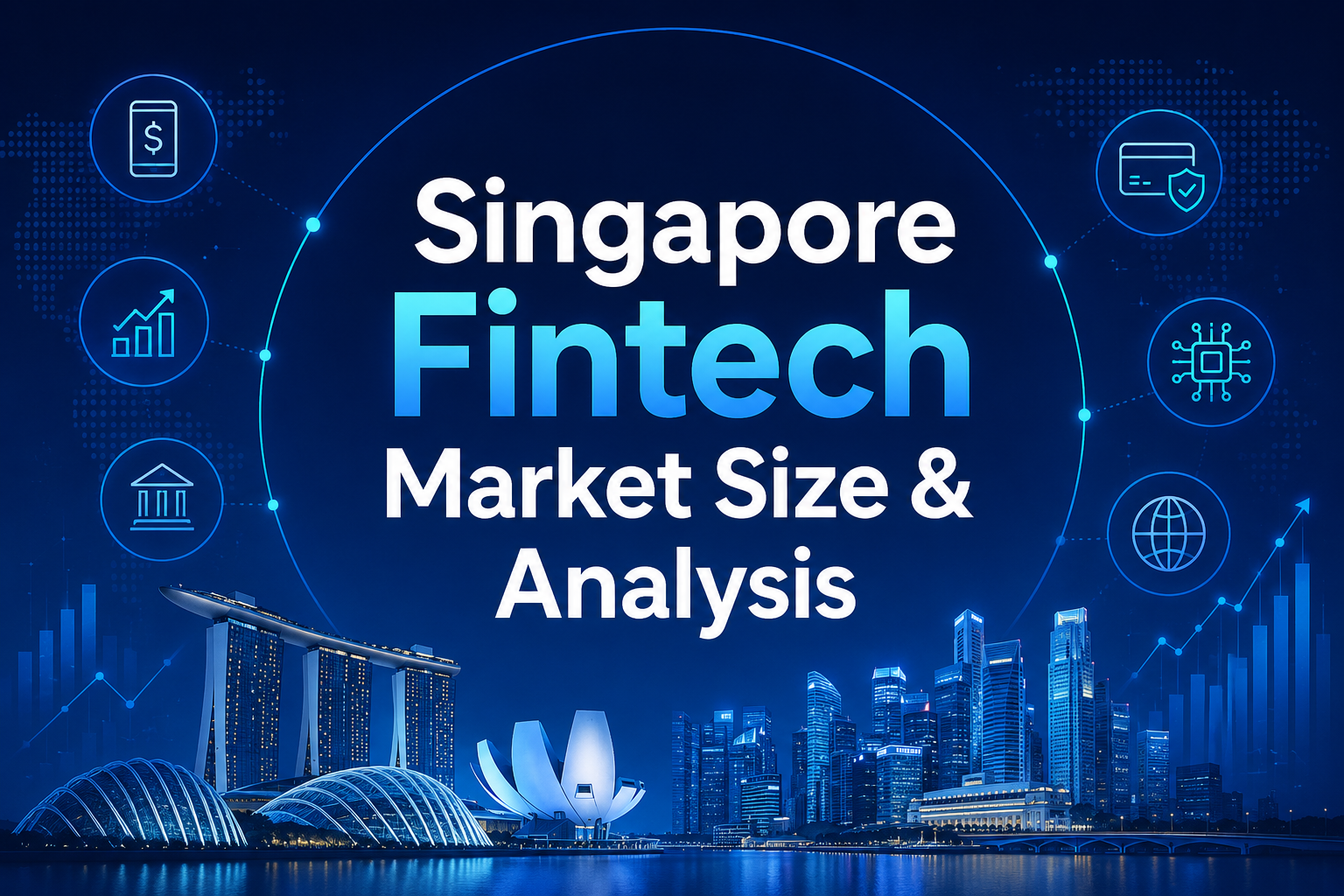
Singapore Fintech Market Size & Analysis 2026
Singapore remains one of the world’s leading fintech hubs, serving as a gateway to Southeast Asia’s rapidly growing digital economy. Supported by strong government initiatives, progressive regulation, high digital adoption, and a vibrant startup ecosystem, the Singapore fintech market continues to attract global investors, financial institutions, and technology innovators.
Key growth areas include digital payments, digital banking, wealthtech, insurtech, regtech, embedded finance, and AI-powered financial services. As fintech adoption accelerates across ASEAN, Singapore is well-positioned to strengthen its role as a regional and global fintech powerhouse through innovation, strategic partnerships, and continued investment in financial technology infrastructure.
Introduction
Singapore has transformed itself into one of the most influential fintech ecosystems in the world. Despite its relatively small population of around six million people, the country plays an outsized role in global financial services and technology innovation. Its strategic location, business-friendly environment, world-class infrastructure, and forward-thinking regulators have helped position Singapore as the fintech capital of Southeast Asia.
The country’s fintech sector has grown significantly over the past decade, fueled by government support, digital transformation initiatives, and increasing consumer demand for digital financial services. The Monetary Authority of Singapore (MAS) has been particularly instrumental in fostering innovation through regulatory sandboxes, digital banking licenses, and fintech development programs.
Today, Singapore hosts thousands of fintech companies spanning payments, lending, wealth management, insurance, blockchain, regtech, and digital banking. Global financial institutions such as DBS, OCBC, UOB, HSBC, and Standard Chartered are increasingly collaborating with fintech startups to accelerate innovation.
As digital finance becomes a key pillar of economic growth, understanding the Singapore fintech market size, trends, investment landscape, and future opportunities is essential for investors, fintech founders, and financial institutions worldwide.
Singapore Fintech Market Overview
Singapore’s fintech ecosystem is among the most mature in Asia-Pacific. The country acts as a regional headquarters for many international financial institutions and technology companies seeking access to Southeast Asia’s growing digital economy.
Several factors contribute to Singapore’s fintech success:
- Strong regulatory framework
- High smartphone and internet penetration
- Government-backed innovation programs
- Access to regional markets
- Stable economic environment
- Deep pool of financial talent
The city-state serves as a launchpad for fintech firms expanding into Indonesia, Malaysia, Thailand, Vietnam, and the Philippines. Collectively, these markets represent hundreds of millions of consumers increasingly adopting digital financial services.
Singapore also ranks consistently among the top global financial centers. This position has enabled the country to attract fintech startups, venture capital firms, accelerators, and multinational banks seeking innovation opportunities.
The ecosystem now includes digital banks, payment providers, blockchain firms, wealthtech startups, insurtech innovators, and AI-driven financial technology companies. As financial institutions continue their digital transformation journeys, fintech partnerships are becoming increasingly important for delivering innovative customer experiences.
Singapore Fintech Market Size and Growth Trends
The Singapore fintech market has experienced remarkable growth over the past decade. The broader fintech industry continues to benefit from rising digital payment adoption, increased mobile banking usage, and growing demand for embedded financial services.
Several trends are driving market expansion:
Digital Payments Growth
Singapore is moving rapidly toward a cashless economy. Consumers increasingly prefer mobile wallets, QR-code payments, and instant payment systems for everyday transactions.
Popular payment platforms include:
- PayNow
- GrabPay
- Apple Pay
- Google Pay
- DBS PayLah!
Digital payment transaction volumes continue to increase annually, creating opportunities for payment infrastructure providers and fintech innovators.
Rise of Digital Banking
The introduction of digital banking licenses has transformed Singapore’s banking landscape. Digital banks are leveraging AI, cloud computing, and data analytics to deliver personalized financial services.
These institutions are helping drive competition while improving customer experiences across savings, lending, payments, and wealth management.
Embedded Finance Expansion
Embedded finance is becoming increasingly important across e-commerce, logistics, and digital platforms. Businesses are integrating payments, lending, insurance, and banking services directly into customer journeys.
AI Adoption
Artificial intelligence is rapidly reshaping customer service, fraud detection, compliance, credit scoring, and wealth management, creating new growth opportunities across the fintech value chain.
Key Segments Driving Singapore’s Fintech Industry
Singapore’s fintech market encompasses several high-growth sectors.
Payments and Digital Wallets
Payments remain the largest fintech category. Consumers and businesses increasingly rely on real-time payments and digital wallets for convenience and efficiency.
Digital Banking
Digital banks are expanding financial inclusion while delivering innovative customer experiences through mobile-first platforms.
WealthTech
Singapore’s status as a global wealth management center has fueled rapid WealthTech growth.
Key offerings include:
- Robo-advisors
- Digital investment platforms
- AI-powered portfolio management
- Financial planning tools
InsurTech
Insurance innovation continues to accelerate through:
- Digital policy distribution
- Embedded insurance
- Automated claims processing
- Usage-based insurance models
RegTech
Financial institutions face increasing compliance requirements. RegTech solutions help automate:
- AML monitoring
- KYC verification
- Transaction screening
- Regulatory reporting
Blockchain and Digital Assets
Singapore has emerged as a leading blockchain innovation hub, attracting cryptocurrency exchanges, tokenization platforms, and Web3 startups.
Fintech Investment and Funding Landscape
Singapore remains one of Asia’s leading destinations for fintech investment.
The ecosystem attracts funding from:
- Venture capital firms
- Corporate investors
- Sovereign wealth funds
- Private equity firms
- Global financial institutions
Major investment themes include:
- AI-powered fintech
- Digital banking
- Embedded finance
- Payments infrastructure
- WealthTech
- RegTech
- Blockchain innovation
Many international investors view Singapore as a gateway to ASEAN’s rapidly expanding digital economy. Startups headquartered in Singapore often use the country as a base for regional expansion.
Government-backed initiatives also play an important role in supporting innovation through grants, accelerator programs, and startup funding schemes.
Government Support and Regulatory Environment
A major reason for Singapore’s fintech success is its supportive regulatory framework.
The Monetary Authority of Singapore (MAS) actively promotes innovation through:
- Regulatory sandboxes
- Innovation grants
- Fintech festivals
- Open banking initiatives
- Digital banking licenses
Singapore’s balanced regulatory approach allows innovation while maintaining financial stability and consumer protection.
The annual Singapore FinTech Festival has become one of the world’s largest fintech events, attracting thousands of participants from across the global financial ecosystem.
This proactive regulatory environment continues to strengthen Singapore’s reputation as a trusted destination for fintech innovation.
Challenges Faced by the Singapore Fintech Market
Despite its success, the fintech industry faces several challenges.
Intensifying Competition
As more startups enter the market, customer acquisition costs continue to rise.
Regulatory Complexity
Fintech companies operating across multiple countries must navigate different regulatory requirements.
Cybersecurity Risks
Growing digital adoption increases the importance of fraud prevention and cybersecurity investments.
Talent Shortages
Demand for fintech professionals, AI specialists, compliance experts, and software engineers remains high.
Successfully addressing these challenges will be critical to sustaining long-term growth.
Future Outlook for Singapore Fintech
The future of Singapore fintech appears highly promising.
Growth opportunities are expected across:
- AI-powered financial services
- Embedded finance
- Digital banking
- Cross-border payments
- WealthTech
- Green finance
- Digital assets
- Open finance ecosystems
As ASEAN’s digital economy expands, Singapore will likely strengthen its position as the region’s primary fintech innovation hub.
The combination of supportive regulation, strong infrastructure, global connectivity, and investor confidence creates a solid foundation for continued growth.
Key Takeaways
- Singapore remains one of the world’s most influential fintech hubs, serving as a strategic gateway to Southeast Asia’s rapidly expanding digital economy.
- Strong government support, progressive regulation, and MAS-led innovation initiatives continue attracting global fintech startups, investors, and financial institutions.
- Digital payments remain the largest fintech segment, driven by widespread mobile wallet adoption, instant payments, and growing cashless consumer behavior.
- Digital banking is transforming financial services through AI-driven personalization, mobile-first experiences, and increased competition within the banking sector.
- WealthTech, InsurTech, RegTech, and embedded finance are emerging as major growth opportunities for startups and established financial institutions.
- Singapore continues attracting significant fintech investment due to its business-friendly environment, regional connectivity, and strong financial services ecosystem.
- Future growth will be driven by AI, open finance, blockchain innovation, cross-border payments, and ASEAN-wide digital transformation initiatives.
Conclusion
Singapore’s fintech journey demonstrates how strategic policymaking, regulatory innovation, and ecosystem collaboration can create a globally competitive financial technology hub. The country has successfully positioned itself as the leading fintech center in Southeast Asia while maintaining strong global relevance.
The market’s growth is being fueled by digital payments, digital banking, wealth management innovation, AI adoption, embedded finance, and blockchain technologies. At the same time, strong support from the Monetary Authority of Singapore continues to encourage innovation while ensuring financial stability and consumer protection.
For investors, Singapore offers access to one of the world’s most dynamic fintech ecosystems and a gateway to the broader ASEAN market. For startups, it provides a supportive environment for innovation and regional expansion. For financial institutions, it serves as a testing ground for next-generation financial services.
As technology continues reshaping finance globally, Singapore is expected to remain at the forefront of fintech innovation, investment, and digital financial transformation throughout 2026 and beyond.
FAQs
1. Why is Singapore considered a fintech hub?
Singapore combines strong regulation, government support, advanced digital infrastructure, investor access, and strategic ASEAN market connectivity, making it one of the world’s leading fintech ecosystems.
2. How large is the Singapore fintech market?
Singapore hosts thousands of fintech companies across payments, banking, wealth management, insurance, blockchain, and regulatory technology, making it one of Asia-Pacific’s largest fintech ecosystems.
3. Which fintech sectors are growing fastest in Singapore?
Digital payments, digital banking, WealthTech, embedded finance, AI-powered financial services, RegTech, and blockchain innovation are among Singapore’s fastest-growing fintech segments.
4. What role does MAS play in fintech development?
The Monetary Authority of Singapore supports innovation through regulatory sandboxes, digital banking licenses, grants, fintech events, and policies that encourage responsible innovation.
5. Why do fintech startups choose Singapore?
Startups benefit from access to capital, supportive regulations, skilled talent, strong infrastructure, and opportunities to expand into Southeast Asia’s fast-growing digital economy.
6. Is Singapore attractive for fintech investors?
Yes. Singapore offers a mature fintech ecosystem, strong governance, regional market access, and consistent innovation, making it highly attractive to global investors.
7. What is the future of fintech in Singapore?
The future will likely be driven by artificial intelligence, embedded finance, digital banking, blockchain innovation, open finance ecosystems, and growing ASEAN digital financial adoption.