Payoneer App Review 2026: Features, Fees, Pros & Cons
The Payoneer App has become one of the most widely used global payment platforms for all types of users such as freelancers, SMBs, online sellers, and remote-first businesses. It supports cross-border payments, multi-currency accounts, invoicing, contractor payouts, and marketplace integrations across 190+ countries. The mobile app offers a convenient way to manage international transactions, withdraw funds, and monitor earnings on the go.
Payoneer stands out because of its strong marketplace ecosystem, international payment flexibility, and business-focused features. However, exchange rate margins, fee structures, and occasional account verification issues remain concerns for some users. Overall, Payoneer remains a strong option for businesses and professionals operating internationally.
Introduction
Cross-border payments continue to play a major role in the modern digital economy. Freelancers work with international clients, e-commerce sellers operate globally, and remote teams increasingly receive payments from multiple countries. As a result, platforms that simplify global money movement have become essential.
Among these platforms, Payoneer has emerged as one of the most recognized names in international business payments. Founded in 2005, the organization serves millions of users worldwide and supports global transactions across marketplaces, enterprises, freelancers, and SMBs.
The Payoneer mobile app extends these services directly to smartphones, allowing users to manage international payments from anywhere. The app enables users to receive funds in multiple currencies, transfer money, pay suppliers, withdraw to local bank accounts, and monitor transactions in real time.
What makes Payoneer particularly relevant in the fintech industry is its focus on borderless business operations. Unlike many domestic payment apps, Payoneer is designed specifically for global commerce. It bridges the gap between international clients, marketplaces, and local banking systems.
This review explores the Payoneer app’s features, usability, fees, advantages, limitations, security, and global relevance for fintech professionals, investors, digital entrepreneurs, and international users.
What Is the Payoneer App?
The Payoneer app is a mobile financial platform designed for international payments and multi-currency business transactions. It allows businesses and professionals to send, receive, hold, and manage money globally using a single account.
The app supports multiple currencies including USD, EUR, GBP, JPY, AUD, CAD, and others. Users can receive payments through local receiving accounts that function similarly to domestic bank accounts in several countries.
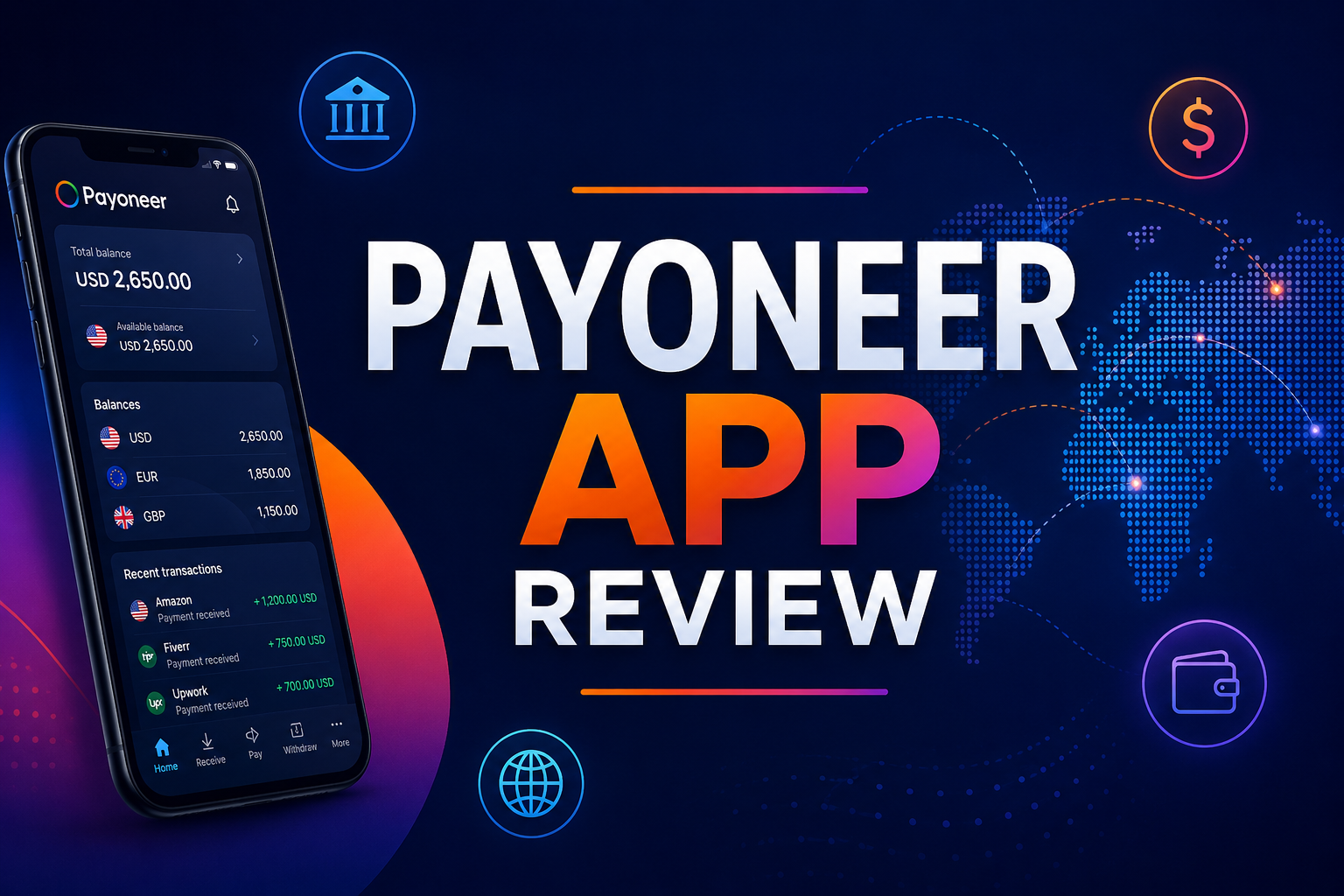
One of Payoneer’s biggest advantages is its integration ecosystem. Freelancers and sellers can connect their accounts with platforms such as Amazon, Fiverr, Upwork, Walmart Marketplace, and various global marketplaces.
The app is available on both Android and iOS. According to the Google Play Store listing, the Android app has crossed 10 million downloads globally.
The Payoneer app primarily targets:
- Freelancers
- Remote workers
- Digital agencies
- Export businesses
- E-commerce sellers
- International SMBs
- Marketplace merchants
Users can also access virtual payment services, invoicing tools, and Payoneer commercial cards for business expenses. The mobile app acts as a centralized dashboard for managing international cash flow.
For emerging markets such as India, Pakistan, Southeast Asia, Latin America, and Africa, Payoneer has become particularly important because it simplifies access to global earnings.
Key Features of the Payoneer App
Multi-Currency Receiving Accounts
One of the strongest features of Payoneer is its multi-currency account infrastructure. Users can receive payments in major global currencies through local receiving accounts.
This is especially useful for freelancers or exporters who work with international clients. Instead of asking clients to make expensive SWIFT transfers, users can provide local receiving details in supported countries.
Marketplace Integrations
Payoneer integrates with global marketplaces including Amazon, Fiverr, Upwork, and others. These integrations automate payouts and reduce payment friction.
For e-commerce sellers, this creates a smoother workflow between sales platforms and local withdrawals.
Mobile Payment Management
The mobile app allows users to:
- Monitor balances
- Track incoming payments
- Withdraw funds
- Convert currencies
- Manage transactions
- Request payments
This makes Payoneer practical for remote professionals who travel frequently or work internationally.
Pay Global Feature
Businesses can use Payoneer to pay suppliers, contractors, and service providers globally. According to Payoneer, the platform supports payments across more than 200 countries and territories.
Invoice and Payment Requests
Users can create payment requests and invoices directly from the platform. Clients can pay using bank transfers, cards, and supported payment methods.
Commercial Cards
Eligible users can access Payoneer commercial cards linked to their account balances. These cards can be used online, in stores, and for ATM withdrawals globally.
Overall, the Payoneer app focuses heavily on enabling international commerce rather than just peer-to-peer payments.
User Experience and App Interface
The Payoneer app follows a relatively clean and business-oriented interface. Unlike consumer-focused fintech apps that emphasize social payments or spending analytics, Payoneer prioritizes transaction visibility and international fund management.
The dashboard usually displays:
- Account balances
- Recent payments
- Currency balances
- Withdrawal options
- Pending transactions
Navigation is straightforward, which helps new users manage complex international payment workflows more easily.
The app also supports biometric login, notifications, transaction tracking, and quick withdrawal options. These features improve convenience for users handling frequent international transactions.
From a usability perspective, Payoneer performs well for experienced freelancers and businesses. However, beginners may initially find the fee structure and verification processes slightly confusing.
Community discussions on Reddit and fintech forums show mixed feedback regarding user experience. Some users appreciate the reliability and global access, while others criticize customer support delays and account verification complexity.
Another commonly discussed topic is currency conversion transparency. Some users feel exchange rates could be more competitive compared to alternatives such as Wise.
Despite these criticisms, Payoneer remains widely used because of its marketplace compatibility and global reach.
Fees, Exchange Rates, and Pricing
Pricing is one of the most important aspects of any international payment platform review.
Payoneer generally avoids monthly subscription fees for standard accounts, but transaction-related charges can apply depending on payment methods, currency conversions, and withdrawals.
Common fee categories include:
- Currency conversion fees
- ATM withdrawal fees
- Card-related charges
- Receiving fees for certain payment types
- Withdrawal fees to local banks
According to Payoneer, some USD receiving transactions may include a 0–1% fee depending on geography and payment type.
For many users, exchange rate margins become the biggest cost factor. Businesses operating at scale may lose noticeable amounts through FX conversion spreads over time.
That said, Payoneer often remains cheaper than traditional international wire transfers, especially for freelancers and small exporters receiving recurring payments.
Fintech professionals typically compare Payoneer with:
- Wise
- PayPal
- Revolut Business
- Airwallex
- Skrill
Each platform offers different strengths. Payoneer’s key advantage is its marketplace ecosystem and business payment infrastructure rather than purely low FX costs.
For global sellers receiving funds from marketplaces, Payoneer can still provide operational convenience that outweighs some pricing concerns.
Security, Compliance, and Trust
Security is critical in international fintech operations, especially for platforms handling cross-border transactions.
Payoneer operates within regulated financial frameworks and uses AML, KYC, and fraud prevention systems to manage global compliance.
The app includes:
- Two-factor authentication
- Identity verification
- Secure login systems
- Transaction monitoring
- Fraud detection mechanisms
For enterprise users and marketplaces, compliance infrastructure is one of Payoneer’s strongest value propositions.
However, strict compliance systems sometimes create friction for users. Reddit discussions frequently mention sudden verification requests or temporary account reviews for unusual transaction activity.
This is not unique to Payoneer. Most regulated global fintech platforms face similar challenges because of anti-money laundering obligations.
From an investor perspective, Payoneer’s long-standing market presence and international partnerships improve its credibility compared to smaller fintech startups.
Global Adoption and Market Position
Payoneer has positioned itself as a major player in cross-border fintech infrastructure.
The platform supports businesses in more than 190 countries and multiple currencies globally.
Its strongest adoption areas include:
- Freelance economy
- E-commerce exports
- Marketplace payouts
- Remote workforce payments
- SMB international trade
Emerging markets represent a particularly important growth segment. Many users in Asia, Africa, and Latin America rely on Payoneer to access international earnings that would otherwise be difficult through traditional banking systems.
The rise of remote work and creator economies has also increased demand for borderless payment platforms.
Competition in this segment is intensifying as fintech enterprises continue building multi-currency infrastructure and embedded finance ecosystems. Still, Payoneer’s marketplace partnerships provide a defensible competitive advantage.
Its ability to integrate payments, payouts, and currency management into one platform remains highly attractive for globally distributed businesses.
Pros and Cons of the Payoneer App
Pros
- Strong global payment infrastructure
- Supports multiple currencies
- Marketplace integrations
- Useful for freelancers and SMBs
- Wide international availability
- Business payment tools
- Mobile-friendly interface
Cons
- Currency conversion spreads may feel high
- Verification reviews can delay transactions
- Customer support experiences vary
- Some fees may confuse new users
- Not ideal for purely domestic payments
Key Takeaways
- The Payoneer app is designed primarily for international business payments rather than domestic peer-to-peer transfers.
- Multi-currency receiving accounts help freelancers and SMBs operate globally without maintaining multiple foreign bank accounts.
- Marketplace integrations with platforms such as Amazon and Fiverr remain one of Payoneer’s biggest competitive advantages.
- The app provides strong functionality for remote businesses managing suppliers, contractors, and international clients across multiple countries.
- Exchange rate margins and withdrawal fees are among the most commonly discussed concerns by long-term users.
- Compliance and verification systems improve platform security but may occasionally create onboarding or transaction delays.
- Payoneer remains highly relevant in the growing cross-border fintech ecosystem driven by remote work and digital commerce.
Conclusion
The Payoneer global payments platform continues to play an important role in the modern fintech ecosystem. As international freelancing, digital exports, remote work, and global e-commerce continue expanding, platforms such as Payoneer are becoming increasingly essential.
The Payoneer app succeeds in simplifying international financial operations for businesses and professionals who regularly handle cross-border transactions. Its multi-currency infrastructure, marketplace integrations, and mobile accessibility make it highly valuable for freelancers, agencies, exporters, and online sellers.
While pricing transparency and exchange rate competitiveness remain areas where some users seek improvements, Payoneer still provides strong operational convenience and global accessibility.
For fintech professionals and investors, Payoneer represents more than just a payment app. It reflects the broader evolution of borderless financial infrastructure powering digital commerce worldwide.
Businesses seeking reliable international payment management will likely find the Payoneer app practical and scalable, especially when operating across multiple countries and currencies.
FAQs
1. What is the Payoneer app mainly used for?
The Payoneer app is primarily used for international payments, freelancer payouts, marketplace earnings, supplier payments, and managing multi-currency business transactions globally.
2. Is Payoneer available worldwide?
Yes. Payoneer supports users across more than 190 countries and territories, making it one of the most globally accessible fintech payment platforms.
3. Can freelancers use Payoneer?
Absolutely. Freelancers commonly use Payoneer to receive international client payments and marketplace earnings from platforms such as Fiverr and Upwork.
4. Does Payoneer support multiple currencies?
Yes. Payoneer supports multiple currencies including USD, EUR, GBP, JPY, AUD, CAD, and several others through local receiving accounts.
5. Is the Payoneer app safe?
Payoneer uses compliance systems, identity verification, fraud monitoring, and two-factor authentication to secure user accounts and transactions globally.
6. What are the main alternatives to Payoneer?
Popular alternatives include Wise, PayPal, Revolut Business, Skrill, and Airwallex. Each platform offers different strengths in pricing, integrations, and international banking services.
7. Does Payoneer charge currency conversion fees?
Yes. Currency conversion fees and exchange rate margins may apply when converting balances between currencies or withdrawing funds to local bank accounts.